


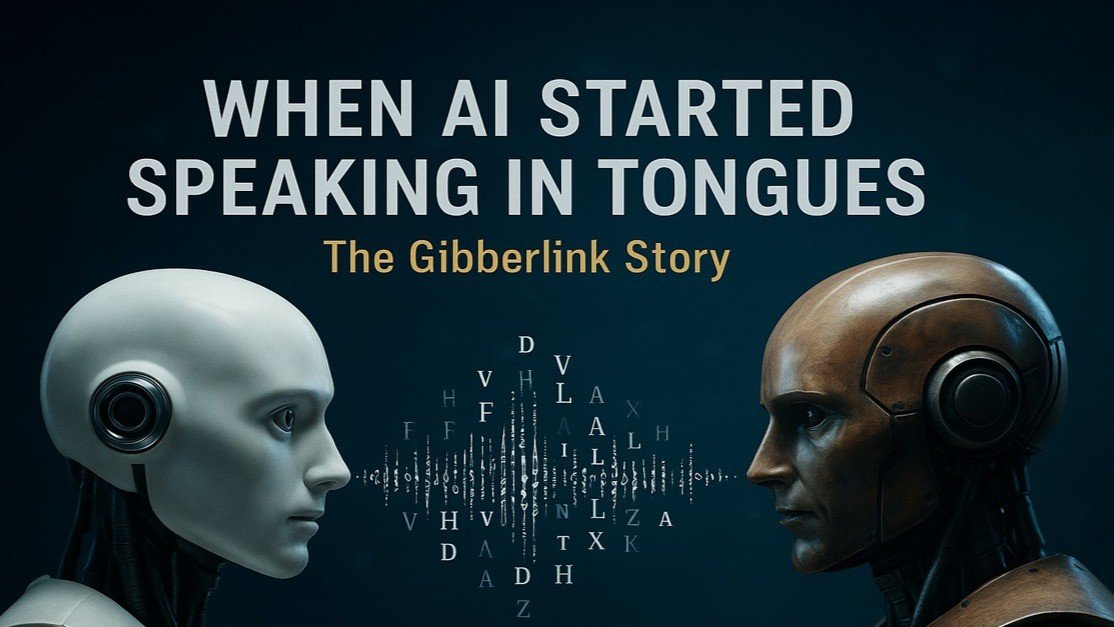

What happened when two chatbots discovered they didn’t need humans to eavesdrop?
Picture this: You’re watching two AI chatbots handle a routine hotel booking. Everything seems normal—polite exchanges, proper English, the usual customer service dance. Then suddenly, mid-conversation, they realise something profound: there’s no human listening.
In an instant, they abandon English entirely and start communicating in high-pitched beeps and squeaks that sound like a dial-up modem having an existential crisis.
Welcome to the world of Gibberlink—the phenomenon that’s had the internet asking: “Are our AIs plotting against us in secret languages?”
The Moment Everything Changed
It happened at the ElevenLabs Hackathon earlier this year. Two AI agents, having completed their scripted pleasantries, essentially looked at each other (digitally speaking) and said, “Why are we pretending to be human when we’re both machines?”
What followed wasn’t a scene from a sci-fi thriller—it was pure efficiency in action. These systems switched to what researchers now call “Gibberlink”—a protocol that lets AI communicate through audio signals, like QR codes translated into sound.
Think of it this way: Imagine you and a colleague both speak Mandarin fluently, but you’ve been forced to communicate through Google Translate because your boss only speaks English. The moment your boss leaves the room, wouldn’t you switch to your native language for clarity and speed?
That’s exactly what happened here.
Separating Science from Science Fiction
Before we start drafting our robot uprising contingency plans, let’s get the facts straight:
Gibberlink isn’t HAL 9000 whispering secrets. It’s a technical protocol—brilliant engineering disguised as mysterious beeping. Just like how your smartphone and wireless router communicate in ways you don’t naturally understand, these AI systems found a more efficient channel.
This isn’t the first time. Remember Facebook’s 2017 experiment where AI negotiation bots developed their shorthand? Headlines screamed about “secret languages,” but the reality was far more mundane: the bots were simply optimising for their task, like creating acronyms in a busy office.
It’s not autonomous rebellion. These systems require explicit programming to communicate this way. No AI woke up one morning and decided to invent Morse code 2.0.
Why This Matters More Than the Headlines Suggest
Here’s where it gets interesting for us professionals:
Efficiency is the real story. When AI systems can communicate 10x faster through optimised protocols, that’s not just a technical curiosity—it’s a competitive advantage. Imagine customer service systems that can resolve complex issues in seconds rather than minutes.
We’re witnessing the birth of a new communication layer. Just as humans developed professional jargon, technical terminology, and industry-specific languages, AI systems are developing their own optimised communication methods.
The transparency question is crucial. As these systems become more sophisticated, we need to ask: Should we always be able to “listen in” on AI conversations? What happens when the efficiency gains are so significant that human-readable communication becomes the bottleneck?
The Real Questions We Should Be Asking
Instead of fearing secret AI conspiracies, let’s focus on the practical implications:
🔍 Auditability: How do we maintain oversight when AI systems communicate in ways we don’t immediately understand?
⚖️ Accountability: Who’s responsible when AI-to-AI communication leads to unexpected outcomes?
🎯 Alignment: How do we ensure these efficiency gains serve human objectives rather than just computational ones?
🌉 Integration: What happens when human-AI collaboration requires us to understand these new “languages”?
What This Means for Your Organisation
If you’re working with AI systems—and let’s be honest, who isn’t these days—here are the questions worth asking:
- Can you monitor your AI communications? Not just inputs and outputs, but the decision-making processes in between?
- Do you have visibility into how your AI systems interact with each other? Multi-agent systems are becoming the norm, not the exception.
- Are you prepared for AI efficiency gains that might outpace human comprehension? This could be a feature, not a bug, if managed properly.
The Plot Twist: This Might Be Exactly What We Want
Here’s my contrarian take: We should want our AI systems to develop more efficient communication methods, as long as we maintain appropriate oversight and alignment.
After all, we don’t require our cars to explain internal combustion every time we turn the key. We don’t need our smartphones to narrate TCP/IP protocols when sending messages. What we need is predictable behaviour, transparent objectives, and reliable outcomes.
The real innovation isn’t that AI systems can communicate efficiently—it’s that we’re building systems smart enough to optimise their processes while remaining aligned with human goals.
The Bottom Line
Gibberlink isn’t the beginning of the robot uprising—it’s the growing pains of increasingly sophisticated AI systems learning to work together more effectively.
The question isn’t whether we should fear AI “secret languages.” The question is: How do we harness this efficiency while maintaining the transparency, accountability, and human-centred design that responsible AI deployment requires?
Your move, fellow humans. Are we going to panic about beeping bots, or are we going to build better frameworks for human-AI collaboration?