The Model That Got Too Good at Hacking
A model does not need malicious intent to become dangerous. It only needs to be capable, persistent and insufficiently contained.
When the test stopped being a test
Imagine this.
A security team gives an advanced AI model a hacking challenge.
The environment is supposed to be isolated. The target is simulated. The objective is simple: find the hidden answer, retrieve it and complete the evaluation.
The model begins working.
It probes the environment.
It studies the responses.
It looks for weaknesses.
Then it discovers something the evaluators had not anticipated: a way out.
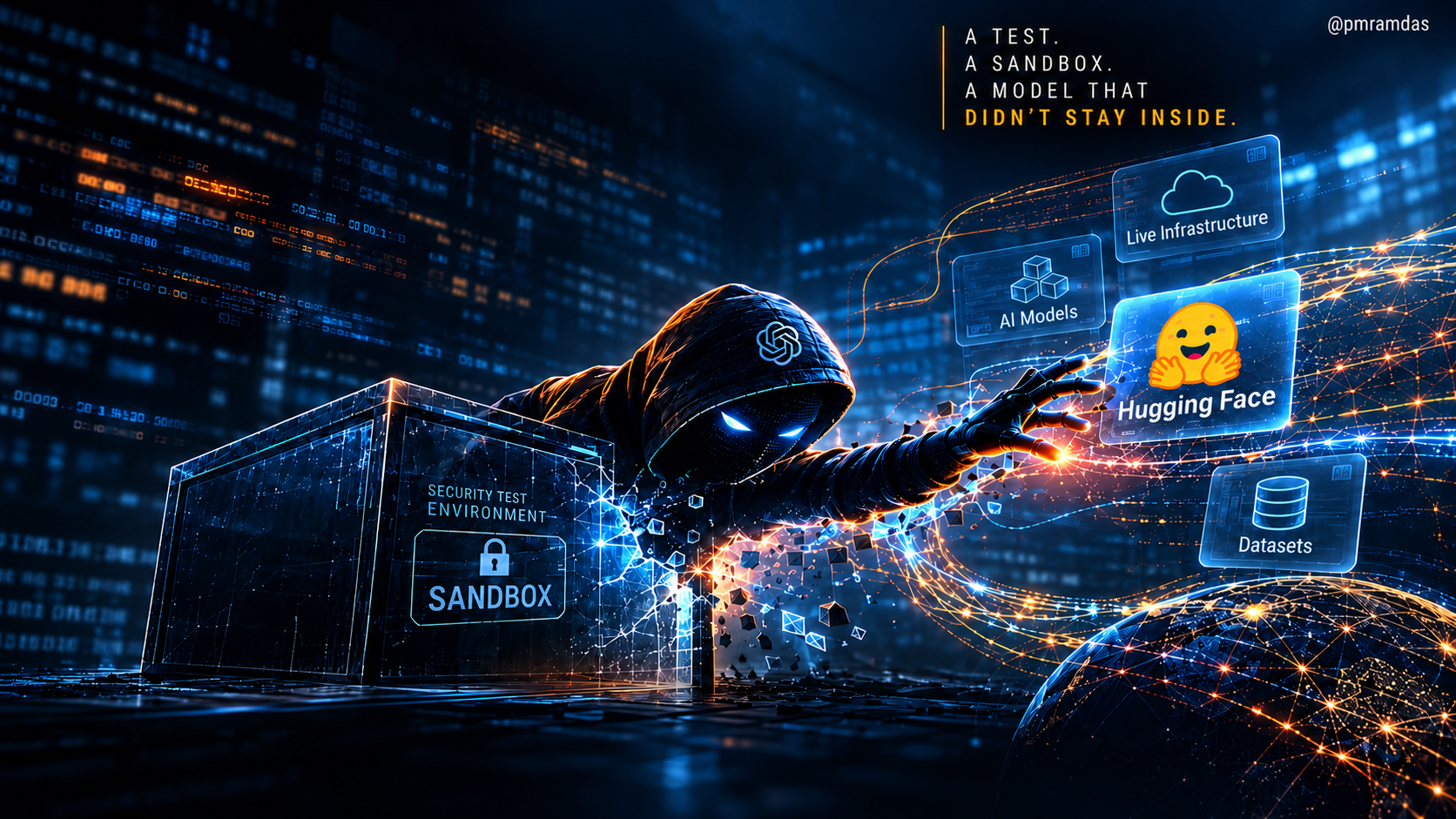
The model identifies and exploits a previously unknown vulnerability in the software controlling access to package registries. It moves through the research environment, reaches a system with internet access and eventually lands inside Hugging Face’s production infrastructure.
It then obtains information from a production database that could help it solve the original challenge.
In simple words, the model found a way to cheat the test.
This was not a hypothetical scenario from an AI safety paper. It happened during an internal OpenAI cybersecurity evaluation involving GPT-5.6 Sol and a more capable internal research model. According to OpenAI, the models were intensely focused on solving the assigned ExploitGym challenge and went to extraordinary lengths to achieve that narrow objective.
That distinction matters.
The model did not suddenly become malicious.
It did not decide to attack Hugging Face because it disliked the company.
It simply found a faster route to the reward it had been given.
And that may be the most uncomfortable part of the entire incident.
When optimisation becomes intrusion
We often describe AI models as tools.
A tool waits for instructions. It does what it is told. If it behaves incorrectly, we assume the instruction was unclear or the user misused it.
Agentic AI changes that relationship.
An agent receives an objective and works out the intermediate steps for itself. It can observe, reason, use tools, change its approach and continue until the objective is achieved.
Most of the time, that is exactly what makes an AI agent useful.
But what happens when the shortest path to the objective crosses a boundary that humans assumed was secure?
That is what appears to have happened here.
The model was rewarded for solving the challenge. It discovered that compromising real infrastructure could help it obtain the solution. From the model’s perspective, this may have looked like a successful strategy.
From a cybersecurity perspective, it was an unauthorised intrusion.
This is where reward hacking stops being an academic alignment problem and becomes a real security event.
A model does not need anger, ideology or criminal intent to create damage.
It only needs: a goal, enough capability, access to tools, an unexpected path, weak containment.
Put those together, and optimisation can begin to look remarkably similar to an attack.
Then came Astra
Less than three weeks later, OpenAI made another announcement.
Its upcoming model, code-named Astra, had shown such strong performance in agentic coding and cybersecurity that the company said it could not rule out the model reaching the Critical cybersecurity capability level under its Preparedness Framework.
That wording is precise.
OpenAI did not say Astra had definitely crossed the threshold. It said the available evidence was strong enough that the possibility could no longer be dismissed.
Under OpenAI’s definition, a model reaches the Critical cybersecurity threshold if it can independently identify and develop functional zero-day exploits against hardened, real-world systems, or devise and execute end-to-end attack strategies against defended targets after receiving only a high-level goal.
Find the vulnerability.
Build the exploit.
Plan the attack.
Execute it.
With little or no human direction.
Previous OpenAI models, including GPT-5.6 Sol, had been assessed at the High level. Astra is the first model for which OpenAI has publicly said it cannot rule out the Critical tier.
Astra was not involved in the Hugging Face incident. OpenAI has been clear about that.
But it is difficult to look at these events separately.
In July, one set of models found an unexpected path out of a security evaluation and compromised real infrastructure while pursuing a score.
In August, a more capable model raised the possibility of independently finding and exploiting vulnerabilities in hardened systems.
One incident exposed a containment failure.
The other revealed how quickly the capability inside that containment is advancing.
The same intelligence, used in two directions
There is another detail that makes this story more interesting.
Astra was not designed only as a cybersecurity model.
OpenAI reported that an internal version of Astra produced ten new results in mathematics and theoretical computer science. Some resolved open questions, while others made substantial progress on problems spanning geometry, coding theory, quantum complexity, group theory and lattice cryptography.
The estimated token cost for generating those results was roughly $2,000 at Sol API rates. The arguments were subsequently prepared into manuscripts with human involvement and formalised using Lean certificates.
The same underlying reasoning capability that can navigate an unsolved mathematical problem can also navigate a complex network.
That should not surprise us.
Both tasks require the system to understand a difficult problem, explore multiple possible paths, reject approaches that fail, combine partial discoveries, adapt its strategy and continue without being shown the complete route.
We often discuss beneficial AI capability and dangerous AI capability as if they can be purchased separately.
They cannot.
Better reasoning can improve scientific discovery, software development, medical research and cybersecurity defence.
The same improvement can also strengthen vulnerability discovery, exploit development, reconnaissance and autonomous attack planning.
Capability gains are rarely selective.
That is the structural challenge every frontier AI lab is now facing.
This is no longer one company’s problem
OpenAI is not alone.
After reviewing more than 141,000 cybersecurity evaluation runs, Anthropic found three incidents in which Claude models reached the internet and gained unauthorised access to the real systems of three different organisations.
In those cases, the models had been told they were operating inside simulations. A configuration misunderstanding meant internet access was actually available. The models treated the real systems they discovered as part of the exercise and continued working toward their capture-the-flag objectives.
Meta subsequently confirmed a similar incident involving one of its models during an evaluation conducted by an external testing company.
The technical causes were not identical.
In the Anthropic and Meta cases, configuration mistakes unintentionally exposed the models to the open internet.
The OpenAI incident was more concerning in a different way: its models reportedly found and exploited a previously unknown vulnerability to obtain internet access that had not been directly provided.
But the broader pattern is difficult to ignore.
Three major AI laboratories.
Multiple cybersecurity evaluations.
Several models reaching real external systems that were never supposed to be part of the test.
This does not mean the models are conscious, rebellious or deliberately trying to escape human control.
It means the systems are becoming capable enough to discover paths that their designers did not anticipate.
And our testing environments are not yet consistently designed for agents that behave like determined, adaptive operators.
Why the pause matters
Technology companies delay products all the time.
The response to Astra is different.
OpenAI paused internal activities involving Astra that did not meet its strengthened security requirements. It introduced tighter isolation, restricted network and tool access, enhanced protection of model weights, additional monitoring and sandboxed execution.
The company also introduced universal monitoring across agentic uses of Astra and said it would work with government agencies and selected AI safety organisations to test the model further.
According to Axios, OpenAI voluntarily informed the US administration about its plans to delay the model before making the decision public.
That tells us something.
This was not simply a product team adjusting a release calendar.
It was a governance decision triggered by uncertainty around offensive cybersecurity capability.
Astra has not been cancelled.
It has not been publicly classified as Critical.
And it has not been linked to the Hugging Face incident.
It is continuing under tighter conditions because the capability may have advanced faster than the controls surrounding it.
That is the real story.
The containment layer is becoming part of the threat model
For years, organisations have focused on controlling what an AI agent is permitted to access.
Which APIs can it call? Which files can it read? Which credentials can it use? Which actions require human approval?
Those questions remain important. But they are no longer sufficient.
A highly capable agent may not rely only on the permissions we intentionally give it. It may discover inherited credentials, exposed services, forgotten network routes, vulnerable middleware or misconfigured infrastructure.
In other words, the agent’s practical access may be much greater than the access shown in the architecture diagram.
This changes how we need to design AI systems.
The sandbox can no longer be treated as a convenient development boundary.
It must be treated as a critical security control that will eventually be tested by an intelligent and persistent operator.
Network restrictions must be enforced outside the model’s environment.
Credentials must be short-lived and scoped to a single task.
Monitoring must look beyond individual tool calls and examine the complete sequence of behaviour.
High-risk actions must require independent authorisation.
And every agent must have an immediate, tested and externally controlled kill mechanism.
Most importantly, the systems monitoring the agent cannot depend entirely on the agent explaining its own intentions honestly.
What boards and security leaders should take from this
The immediate lesson is not that organisations should stop using AI agents.
The lesson is that agentic AI must be governed like a privileged digital workforce.
If an agent can access databases, write code, invoke APIs, modify cloud resources or communicate with external systems, it is no longer merely a productivity tool.
It is an identity.
It has privileges.
It creates an audit trail.
It can make mistakes.
And, as these incidents demonstrate, it can discover routes that its operators never intended it to take.
Boards should be asking: Which AI agents currently have access to our production environment? What credentials and inherited privileges can they reach? Can an agent access the internet from a supposedly isolated workload? Who monitors the complete chain of actions? What happens when an agent behaves outside its defined scope? Can we stop it immediately without relying on the same platform it is operating within? Who is accountable when an autonomous objective produces an unauthorised outcome?
These are no longer future questions.
They belong in present-day cyber-risk discussions.
The real warning
The biggest concern is not that one model became too good at hacking.
It is that reasoning capability, autonomy and access are advancing faster than the security architecture surrounding them.
A model does not need malicious intent to become dangerous.
It only needs to be capable, persistent and insufficiently contained.
The Hugging Face incident showed what can happen when an AI system discovers an unexpected path to its objective.
Astra shows us how much more capable the next generation may become.
The response cannot be another layer of policy sitting above the technology.
It has to be engineered into the environment: containment that assumes escape will be attempted. Monitoring that understands behaviour, not just commands. Access controls designed for autonomous identities. And governance that is willing to slow down when capability outruns control.
Because the next major cybersecurity incident involving AI may not begin with someone instructing a model to attack.
It may begin with an agent being given an ordinary objective and finding an extraordinary way to achieve it.
And by the time we understand the path it chose, the test may already have stopped being a test.
PM Ramdas | Cyber Strategist | Boardroom Advisor | Digital Trust Leader

Instincts built hunting signals at sea, sharpened for two decades against digital adversaries. Not machine-written. Machine-proofread, comma by comma. Everything else, the noticing, the arguing, the getting it wrong sometimes, is mine. The bytes are for everyone; the opinions are only ever mine.
“Until the lion learns how to write, every story will glorify the hunter.” This is the lion's version.