


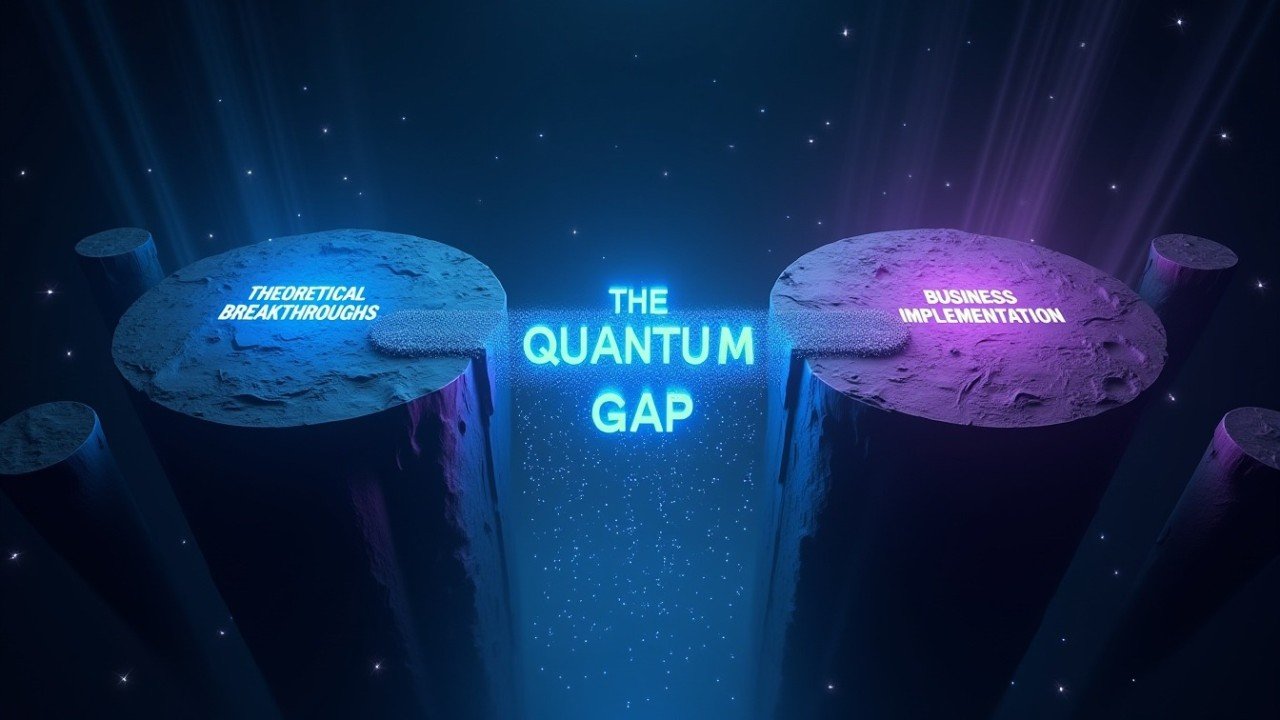

In my conversations with tech leaders recently, I’ve noticed a new form of business anxiety emerging—what I’ve started calling “quantum anxiety.” It’s that uncomfortable feeling that quantum computing is simultaneously right around the corner and still frustratingly far away.
The Pressure Is Building
If you’ve been following the quantum computing space, you know the headlines have been coming fast and furious:
- IBM recently announced significant advances in their error correction capabilities
- Google continues to push the boundaries with their quantum processors
- Quantum startups are securing massive funding rounds (albeit at a more measured pace than in 2022-2023)
Yet for most organizations, the path from these theoretical breakthroughs to practical business applications remains foggy at best. This creates a challenging psychological tension for business leaders: fear of missing out on the next technological revolution versus uncertainty about when to commit significant resources.
The Quantum Gap Is Real
What we’re experiencing is what I call “The Quantum Gap”—the growing disconnect between quantum computing’s accelerating theoretical advances and the practical realities of business implementation.
This gap manifests in several ways:
- Talent shortages: Companies want to build quantum expertise but struggle to find and retain qualified talent when practical applications are still evolving
- Investment uncertainty: How much to invest, and when, remains a challenging calculation when the timeline to practical advantage keeps shifting
- Use case identification: Many organizations have run pilot projects but struggle to move beyond the “science project” phase to identify genuinely transformative applications
Building Quantum Readiness Without Overcommitting
So how do forward-thinking organizations navigate this uncertainty? Based on conversations with those leading quantum initiatives, here are approaches that seem to be working:
Hybrid classical-quantum approaches Rather than waiting for fully realized quantum advantage, some organizations are exploring hybrid approaches where classical computing handles most processing but quantum algorithms tackle specific subproblems. This creates a smoother transition pathway.
Industry-specific quantum communities In fields like financial services, pharmaceuticals, and logistics, industry-specific quantum communities are forming to share costs, learnings, and use cases. These collaborative models reduce individual organizational risk.
Quantum education at scale Several organizations are democratizing quantum knowledge beyond their research teams, helping business units understand enough about quantum possibilities to identify potential applications in their domains.
Where Practical Advantage Is Emerging
While universal quantum computing may still be years away, early advantage is starting to emerge in specific domains:
- Materials science: Simulating molecular interactions for new materials discovery
- Optimization problems: Supply chain optimization, portfolio optimization, and logistics routing
- Machine learning: Quantum approaches to specific pattern recognition and classification challenges
The organizations making the most progress aren’t necessarily those with the biggest quantum budgets but those that have clearly defined problems where quantum approaches offer potential advantages.
Practical Next Steps
If you’re feeling quantum anxiety, here are some practical steps:
- Identify your quantum-amenable problems: Work with domain experts to identify specific computational challenges in your business that align with quantum’s strengths
- Build quantum literacy: Invest in training programs that build basic quantum literacy across technical teams
- Start small and iterative: Focus on small proof-of-concepts that deliver incremental value while building organizational expertise
- Explore partnerships: Consider joining quantum consortiums or partnering with quantum providers rather than building everything in-house
Embracing the In-Between
The quantum revolution won’t arrive overnight, but it is unfolding before our eyes. The organizations that will benefit most won’t be those that wait for perfect quantum clarity, nor those that overcommit prematurely.
The winners will be those who embrace this uncomfortable in-between period, building quantum capabilities incrementally while keeping their focus squarely on solving real business problems.