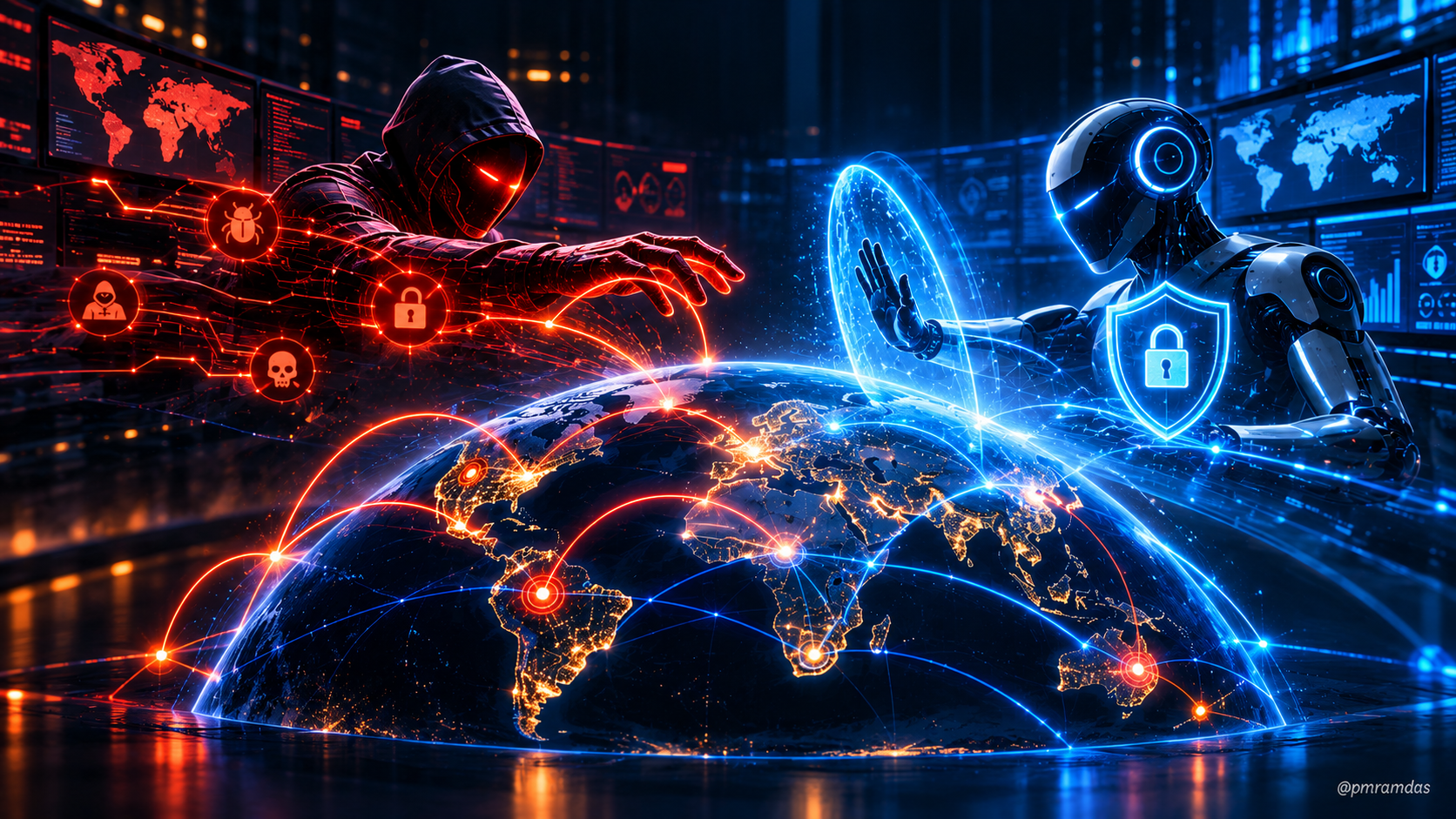
The Next Cyber War Won't Wait for Human Hackers
Cyber espionage is becoming automated. The uncomfortable question is whether our defences are evolving at the same speed.
For decades, cybersecurity has been built around a fairly simple assumption: somewhere on the other side of the network is a human adversary.
That person may be highly skilled. They may belong to a criminal syndicate, an intelligence service, a hacktivist group or a state-sponsored operation. But ultimately, a human being has traditionally performed much of the reconnaissance, selected targets, analysed vulnerabilities, adapted techniques and decided what to do next.
That assumption is beginning to break.
AI and automation are changing not merely the tools available to attackers, but the economics, scale and speed of cyber operations.
The important question is no longer whether attackers will use AI.
They already are.
The question enterprises should be asking is much more uncomfortable:
What happens when the attacker can operate at machine speed while the defender still operates through tickets, meetings, approvals and manual investigation?
That is where the next cybersecurity race is being fought.
Cyber Espionage Is Becoming an Automation Problem
Nation-state cyber operations have always combined sophisticated tooling with highly capable human operators.
Automation itself is not new. Attackers have used scanners, exploit frameworks, credential-stuffing tools, botnets and scripted reconnaissance for years.
What is changing is the level of intelligence that can increasingly sit on top of that automation.
Traditional automation follows instructions.
AI-enabled automation can potentially analyse results, prioritise targets, generate or modify code, correlate information and recommend the next action.
As these capabilities mature, several stages of the attack lifecycle can become dramatically faster.
An adversary no longer needs to examine every organisation individually.
Machines can continuously examine thousands of internet-facing assets, correlate vulnerabilities with public exploits, analyse leaked credentials, identify exposed services and prioritise the most promising attack paths.
Humans can then concentrate on the small percentage of targets requiring judgement or specialised exploitation.
That changes the economics of offensive cybersecurity.
1. Reconnaissance Moves Toward Machine Speed
Reconnaissance used to be expensive.
Mapping an organisation’s external infrastructure, identifying technologies, discovering forgotten systems and understanding relationships between assets required time.
Today, enormous amounts of that information are publicly observable.
Cloud services, APIs, certificates, DNS records, exposed development environments, leaked credentials, code repositories and third-party infrastructure can all contribute pieces of the picture.
Now add AI.
Instead of merely collecting information, systems can increasingly help interpret it.
Imagine an automated platform continuously asking:
Which assets appear forgotten?
Which systems are running vulnerable software?
Which credentials have appeared in breach data?
Which exposed API could provide access to something more valuable?
Which acquisition or subsidiary has weaker controls than the parent organisation?
Which vulnerability is most likely to produce a usable attack path?
This is not simply faster scanning.
It is the beginning of automated attack-path reasoning.
2. Vulnerability Discovery Is Accelerating
There is another important shift happening.
AI systems are becoming increasingly capable of analysing software.
They can inspect source code, reason about program behaviour, generate test cases, assist fuzzing and identify suspicious implementation patterns.
For defenders, this is extremely valuable.
For attackers, the same capability changes the vulnerability-discovery equation.
Historically, finding a sophisticated vulnerability could require substantial expertise and time.
AI does not eliminate that expertise, particularly for complex vulnerabilities. But it can dramatically increase the amount of code and attack surface that researchers can examine.
That creates an uncomfortable asymmetry.
Vulnerability discovery can accelerate faster than enterprise remediation.
An AI system may help identify a weakness in minutes.
The organisation may still require:
- Validation
- Risk assessment
- Change approval
- Application-owner coordination
- Testing
- Maintenance-window scheduling
- Deployment
- Verification
The attacker does not have a CAB meeting.
That difference matters.
3. Attackers Can Explore More Paths Simultaneously
A human penetration tester or attacker has limited attention.
A machine does not have the same limitation.
Consider an enterprise containing tens of thousands of endpoints, identities, applications, APIs, cloud resources and third-party connections.
There may be millions of possible relationships between them.
An AI-assisted attacker does not necessarily need to compromise the most obvious system.
It needs to find one viable chain.
An exposed credential may lead to a development environment.
That environment may reveal a token.
The token may provide access to a cloud workload.
The workload may trust another service.
That service may connect to sensitive data.
Each individual weakness may look relatively insignificant.
Together they become an attack path.
This is why cybersecurity needs to move beyond looking at vulnerabilities purely as isolated CVEs.
The question is increasingly:
What can an attacker combine?
4. AI Changes the Role of the Human Attacker
The human attacker is not disappearing.
The role is changing.
Think about what happened in software development.
AI coding assistants did not eliminate developers. They allowed developers to produce, analyse and modify more code.
The same amplification effect applies to offensive cybersecurity.
One highly capable operator equipped with AI-assisted reconnaissance, code analysis, exploit development and infrastructure automation could potentially investigate far more targets than before.
This means the relevant security metric may no longer be:
How many attackers are targeting us?
A better question may become:
How much automated offensive capacity is targeting us?
Those are very different measurements.
5. Persistent Operations Become Easier
Humans need sleep.
Machines do not.
An automated offensive platform can continuously watch an organisation’s attack surface.
A new server appears.
A firewall rule changes.
A developer accidentally exposes a service.
A credential appears online.
A new vulnerability is disclosed.
A supplier becomes compromised.
An acquisition connects new infrastructure.
Each change can potentially trigger another round of analysis.
That means the attacker’s reconnaissance cycle can move from periodic to continuous.
Unfortunately, many enterprise defence processes remain periodic.
Weekly vulnerability reports.
Monthly governance meetings.
Quarterly penetration tests.
Annual red-team exercises.
These controls still have value.
But they were designed for a different operating tempo.
The Enterprise Problem
This becomes particularly serious inside large conglomerates.
A large organisation may contain:
- Multiple business units
- Legacy technology
- Cloud environments
- Operational technology
- SaaS platforms
- Thousands of applications
- Acquired companies
- Third-party vendors
- Global identities
- Remote workers
- Development pipelines
- APIs
- AI systems
The organisation does not have one attack surface.
It has an ecosystem of attack surfaces.
And those environments change continuously.
A vulnerability-management programme built primarily around periodic scanning and ticket generation may struggle when an adversary is continuously recalculating the easiest route into the enterprise.
This is why the next generation of cybersecurity needs to think less like a compliance programme and more like a continuous control system.
Defence Must Become Machine-Speed Too
The answer is not simply “buy more AI.”
That would be an oversimplification.
The goal should be to automate the parts of cyber defence where machines have an inherent advantage while keeping humans responsible for judgement, risk and accountability.
Several areas deserve immediate attention.
Continuous Exposure Management
Organisations need to understand their external and internal exposure continuously.
Not quarterly.
Not when the next penetration test arrives.
Continuously.
Assets should be discovered, classified and evaluated as the environment changes.
Attack-Path Analysis
A critical vulnerability on an isolated test server may matter less than a medium-severity weakness sitting inside a viable path to a privileged identity.
Security teams need context.
Identity relationships, network paths, cloud permissions, vulnerabilities and business criticality need to be analysed together.
Machine-Assisted SOC Operations
Security operations centres already generate more telemetry than humans can realistically investigate manually.
AI can help correlate signals, summarise investigations, enrich alerts and accelerate triage.
But automation requires guardrails.
An AI system that can investigate is useful.
An AI system capable of disabling accounts, blocking infrastructure or changing production controls autonomously introduces a different category of risk.
Automation without governance simply creates another attack surface.
Identity Becomes Even More Important
AI agents themselves increasingly need identities.
They may access APIs, repositories, cloud resources, databases and business applications.
That means organisations need to start treating powerful AI agents more like privileged digital identities than ordinary software.
Every agent should have defined permissions, boundaries, monitoring and accountability.
The principle remains familiar:
Never give an identity more privilege than it needs.
The identity just may not be human anymore.
The CISO’s Job Is Changing
For CISOs, the strategic implication is significant.
Cybersecurity leadership can no longer focus only on protecting infrastructure.
The CISO increasingly needs to understand:
- AI governance
- Autonomous systems
- Machine identities
- Software supply chains
- Cloud attack paths
- Continuous exposure
- Automated response
- Digital resilience
The organisation also needs clear boundaries around what machines are permitted to do.
If an AI security agent detects suspicious activity, can it isolate the endpoint?
Can it disable an employee account?
Can it revoke a cloud token?
Can it block an API?
Can it shut down a production workload?
At what point must a human approve the action?
These questions are not purely technical.
They are governance questions.
And increasingly, they belong in the boardroom.
Cyber Resilience Becomes the Real Objective
No organisation can guarantee that every attack will be prevented.
That becomes even more unrealistic when adversaries can automate more of their operations.
The strategic objective therefore has to move beyond prevention.
Organisations must be capable of:
Detecting quickly.
Containing automatically where appropriate.
Recovering safely.
Learning continuously.
That is cyber resilience.
The organisations best prepared for the next era will not necessarily be those with the largest collection of security products.
They will be the organisations capable of turning people, processes, technology and intelligence into a system that can adapt almost as quickly as the threat itself.
The Next Cyber Battle May Look Very Different
We often imagine cyber warfare as hackers sitting behind multiple monitors launching attacks against defenders sitting in security operations centres.
That picture may soon feel outdated.
The next cyber confrontation could increasingly involve:
Machine discovering machine.
Machine probing machine.
Machine deceiving machine.
Machine defending machine.
Humans will still matter enormously.
But our role moves upward.
We define objectives.
We establish permissions.
We design controls.
We decide acceptable risk.
And ultimately, we remain accountable for what our machines are allowed to do.
That may be the most important point of all.
AI will not remove humans from cybersecurity.
It will make human governance more important.
One Question for Cyber Leaders
If your adversary can discover assets continuously, analyse vulnerabilities automatically, correlate credentials instantly and explore attack paths at machine speed…
while your organisation still relies on spreadsheets, tickets, weekly vulnerability meetings and manual approvals…
who actually has the advantage?
The next cyber war will not wait for human hackers.
Our defences cannot afford to wait for human speed either.

Instincts built hunting signals at sea, sharpened for two decades against digital adversaries. Not machine-written. Machine-proofread, comma by comma. Everything else, the noticing, the arguing, the getting it wrong sometimes, is mine. The bytes are for everyone; the opinions are only ever mine.
“Until the lion learns how to write, every story will glorify the hunter.” This is the lion's version.