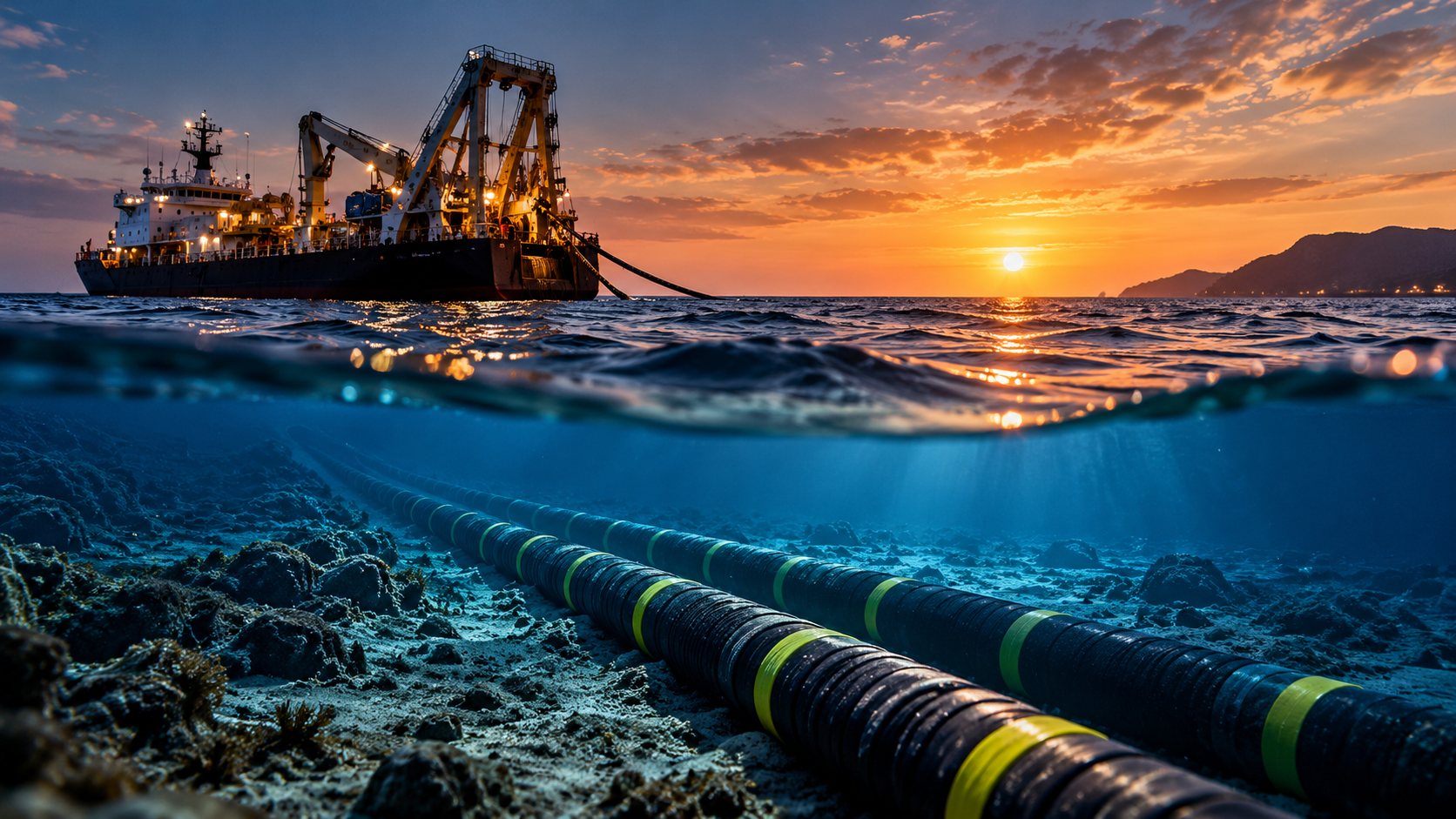
The Undersea Cables Holding the World Together
Most intercontinental data travels on fibre-optic cables along the seabed. Resilience planning that ignores them is incomplete.
The invisible infrastructure beneath our oceans, and the leadership responsibility we can no longer ignore.
Imagine waking up one morning to discover that international banking transactions are failing, global trading platforms are struggling to connect, cloud applications have become painfully slow, and entire countries are experiencing widespread internet disruptions.
No ransomware notification. No compromised administrator account. No suspicious email.
Just a few damaged cables, thousands of metres beneath the ocean.
It sounds like the opening scene of a geopolitical thriller. Yet it represents a very real vulnerability in the infrastructure supporting our connected world.
We spend billions securing data centres, building sophisticated security operations centres, deploying artificial intelligence, and protecting digital identities. But beneath all this technological sophistication lies something remarkably physical.
A network of fibre-optic cables stretching across the ocean floor, quietly carrying the overwhelming majority of intercontinental data traffic.
And most people rarely think about it.
The Internet Has an Ocean Beneath It
When someone mentions global internet connectivity, the immediate picture is usually satellites, cloud infrastructure, wireless networks, and enormous data centres.
The reality is rather different.
According to widely cited telecommunications industry estimates, submarine cables carry approximately 99% of intercontinental data traffic.
There are hundreds of active submarine cable systems worldwide, extending collectively over a million kilometres.
These cables connect continents, financial centres, cloud regions, telecommunications networks, and entire digital economies.
They carry international payments, business communications, video calls, cloud workloads, scientific research, and enormous volumes of everyday internet traffic.
Satellites certainly have their place. They are invaluable for remote connectivity, maritime operations, emergency communications, and locations where terrestrial infrastructure is impractical.
But when it comes to transporting massive quantities of international data with high capacity and relatively low latency, submarine fibre-optic networks remain indispensable.
What fascinates me is the contrast.
We describe the internet as something virtual, distributed, and almost limitless.
Yet much of its international connectivity depends on physical infrastructure resting on the seabed.
The digital world is far more physical than we care to acknowledge.
What My Years in the Navy Taught Me About Invisible Infrastructure
Having spent 15 years in the Indian Navy, I have always looked at the oceans somewhat differently.
For most people, the sea represents trade, travel, tourism, or perhaps a beautiful horizon.
For those who have served at sea, it also represents strategy, logistics, geography, vulnerability, and national security.
The ocean is not merely an expanse of water separating countries. It is an environment through which critical economic and strategic interests move.
Shipping routes matter. Maritime chokepoints matter. Ports matter. Communication infrastructure matters.
And increasingly, submarine cables matter.
During my naval career, I learned an important lesson about operational readiness: the infrastructure that receives the least attention during normal operations can become the most important during a crisis.
Years later, working in enterprise technology and cybersecurity leadership, I find that lesson equally relevant.
Organisations often concentrate their security investments on the infrastructure they can see and directly control.
Firewalls. Endpoints. Identity platforms. Applications. Cloud environments.
But resilience is not determined solely by the strength of systems within our administrative boundaries.
It is also determined by the dependencies beyond them.
And some of those dependencies lie beneath the ocean.
When a Cable Breaks, the Consequences Travel Far Beyond the Seabed
Submarine cables are damaged more frequently than many people realise.
Fishing activities, ship anchors, natural disasters, geological movements, and equipment failures account for many reported incidents.
Not every cable failure represents sabotage.
That distinction matters, especially in an era when geopolitical speculation can spread faster than verified technical information.
However, the consequences of cable disruption can be significant regardless of the cause.
Consider the Red Sea, one of the world’s strategically important telecommunications corridors.
In 2024, damage affecting several submarine cable systems in the region disrupted important international connectivity routes. Network operators had to redirect traffic through alternative paths.
The incident demonstrated how geographic concentration can become a systemic vulnerability.
A network may appear globally distributed on a diagram while still depending on a relatively small number of physical corridors.
That is where conventional thinking about redundancy can become dangerously misleading.
Two network providers do not necessarily mean two independent physical paths.
Two cloud regions do not automatically guarantee independence from the same international connectivity infrastructure.
And multiple telecommunications contracts may offer little protection if their underlying cable routes converge at the same vulnerable location.
Redundancy without physical diversity can create an illusion of resilience.
The New Geography of Cybersecurity
For years, cybersecurity strategy has largely focused on protecting digital assets against unauthorised access, manipulation, disruption, and theft.
Those priorities remain essential.
But the security landscape is expanding.
We must now consider the physical infrastructure supporting digital services as part of the broader cyber risk environment.
A submarine cable is not merely a telecommunications asset.
It can be a component of national economic security.
Financial markets depend on international connectivity. Multinational enterprises depend on global cloud services. Logistics networks depend on continuous information exchange.
Artificial intelligence is increasing the importance of this infrastructure further.
Large-scale AI systems rely on distributed computing resources, data movement, and connectivity between geographically separated environments.
As AI infrastructure becomes more geographically distributed, the resilience of international data pathways becomes increasingly important.
There is also a geopolitical dimension.
Submarine cable routes, landing stations, ownership structures, maintenance capabilities, and repair arrangements can create strategic dependencies.
A nation may invest heavily in sovereign cloud infrastructure and domestic data centres while remaining dependent on international communication routes outside its direct control.
That raises an important question.
Can digital sovereignty truly exist without connectivity sovereignty?
I believe this question deserves far more attention in technology leadership discussions.
What Should Enterprise Leaders Actually Do?
The answer is not to turn every CISO into a maritime security specialist.
It is to recognise that digital resilience requires a broader understanding of infrastructure dependencies.
From a leadership perspective, I would focus on five priorities.
First, understand the real connectivity dependencies.
Ask telecommunications providers and critical technology partners how international connectivity is routed. Identify important landing points, transit corridors, and shared dependencies.
Second, validate physical route diversity.
Contractual redundancy is not enough. Where business criticality justifies it, seek evidence that alternative network paths do not depend on the same vulnerable infrastructure.
Third, test prolonged international connectivity disruption.
Most organisations test ransomware, data-centre failures, and cloud outages. Far fewer examine the business consequences of a major regional submarine cable disruption.
What happens when international connectivity becomes severely degraded for several days?
Which business services fail first?
Can critical operations continue locally?
Fourth, incorporate geopolitical infrastructure risk into enterprise risk management.
Geopolitical developments, maritime incidents, cable repair constraints, and regional infrastructure concentration should inform resilience planning.
This requires collaboration between cybersecurity, enterprise risk, telecommunications, business continuity, and executive leadership.
Finally, challenge assumptions about cloud resilience.
Cloud availability is not the same as end-to-end business availability.
A cloud platform may remain fully operational while customers, employees, or dependent systems struggle to reach it.
Resilience must be measured from the perspective of the business service, not simply the health of the infrastructure provider.
India Has a Particular Reason to Pay Attention
For India, this conversation carries significant strategic importance.
Our ambitions in digital public infrastructure, financial technology, cloud computing, artificial intelligence, and global technology services depend on reliable international connectivity.
India’s extensive coastline and growing digital economy make submarine cable connectivity a matter of economic and strategic interest.
The conversation should therefore extend beyond adding more international bandwidth.
It should include diversified landing locations, geographic route resilience, domestic infrastructure preparedness, repair capabilities, and cooperation between government and industry.
Digital infrastructure planning should increasingly consider the relationship between terrestrial networks, submarine systems, cloud infrastructure, and national security.
The objective is not to eliminate every possible disruption.
That would be unrealistic.
The objective is to prevent a predictable infrastructure dependency from becoming an avoidable national or enterprise crisis.
The Leadership Question Beneath the Surface
Technology leaders are increasingly expected to understand risks that do not fit neatly into traditional organisational boundaries.
The future CISO cannot look exclusively at cyberattacks.
The future CTO cannot evaluate infrastructure solely through performance, scalability, and cost.
And boards cannot assume that operational resilience is guaranteed simply because multiple technology vendors have been contracted.
Real resilience demands an understanding of how systems depend on one another, including dependencies that are geographically distant, physically inaccessible, or managed by third parties.
For me, this is where my experience in the Navy and my years in technology leadership intersect.
At sea, we learned to respect what we could not always see.
In cybersecurity, we must learn to do the same.
Because the most consequential vulnerability in an organisation may not be an unpatched server, an exposed application, or a compromised identity.
It may be an invisible dependency thousands of kilometres away.
And when that dependency fails, the organisation will discover whether its resilience strategy was genuinely designed or merely assumed.
Final Thought
The world has invested extraordinary resources in protecting the intelligence, applications, and data that power our digital economy.
Perhaps it is time we paid equal attention to the infrastructure that allows them to communicate.
The true measure of technology leadership is not how confidently we protect the systems we control, but how intelligently we prepare for the failure of the systems we depend upon.
Because the next great digital crisis may not begin with a line of malicious code. It may begin with a broken cable at the bottom of the ocean.
Further Reading

Instincts built hunting signals at sea, sharpened for two decades against digital adversaries. Not machine-written. Machine-proofread, comma by comma. Everything else, the noticing, the arguing, the getting it wrong sometimes, is mine. The bytes are for everyone; the opinions are only ever mine.
“Until the lion learns how to write, every story will glorify the hunter.” This is the lion's version.