


Why the answer to water pressure is smarter expansion, not slower digital growth ?
Why the answer to water pressure is smarter expansion, not slower digital growth ?
At 2:17 in the morning, a data center looks almost peaceful.
Rows of servers blink in perfect rhythm. Nothing appears to move. Yet inside those machines, a bank is detecting fraud, a hospital is retrieving a critical scan, an airline is recalculating routes, a government platform is authenticating a citizen and an AI system is helping an engineer solve a problem that once took days.
This is no longer optional infrastructure.
Data centers have become the factories, libraries, command posts and public squares of the digital economy. Every serious ambition in artificial intelligence, financial inclusion, healthcare, cybersecurity, sovereign cloud and scientific research depends on them.
The world will need many more.
But behind the server hall, pumps are running. Heat is moving into pipes. Water may be passing through cooling equipment. Somewhere beyond the perimeter fence, a power station may be consuming even more water to generate the electricity keeping those servers alive.
The cloud has a physical address. And that address has a water bill.
Here is the important distinction: that bill is not an argument against building data centers. It is an argument for building them better.
The debate begins with the wrong question
The public discussion is often framed as a choice: data centers or water security.
That is a false choice.
Stopping or slowing digital infrastructure would not make society more resilient. It would push computing capacity elsewhere, increase dependence on distant jurisdictions and weaken the local ecosystems needed for AI, cloud services and cybersecurity. It could also leave countries importing digital capability instead of creating it.
The right question is not, “Should we build more data centers?”
We should.
The right question is, “How do we build far more capacity without exporting environmental cost to the communities hosting it?”
That is an engineering, policy and leadership problem. And it is solvable.
Why more data centers are essential
More capacity is not simply about faster streaming or larger AI models.
It is about economic competitiveness. Companies need low-latency cloud infrastructure close to their customers. Start-ups need affordable access to computing. Banks and payment networks need dependable transaction processing. Manufacturers need industrial analytics. Governments need secure digital public infrastructure.
It is also about national resilience. A country that depends heavily on foreign computing capacity has less control over data jurisdiction, service continuity and strategic technology. Local and regional data-center capacity gives organisations more choices over where sensitive workloads are stored and processed.
Cyber resilience matters too. Concentrating critical systems in too few facilities creates single points of failure. More geographically distributed capacity makes it easier to design redundancy, disaster recovery and operational continuity.
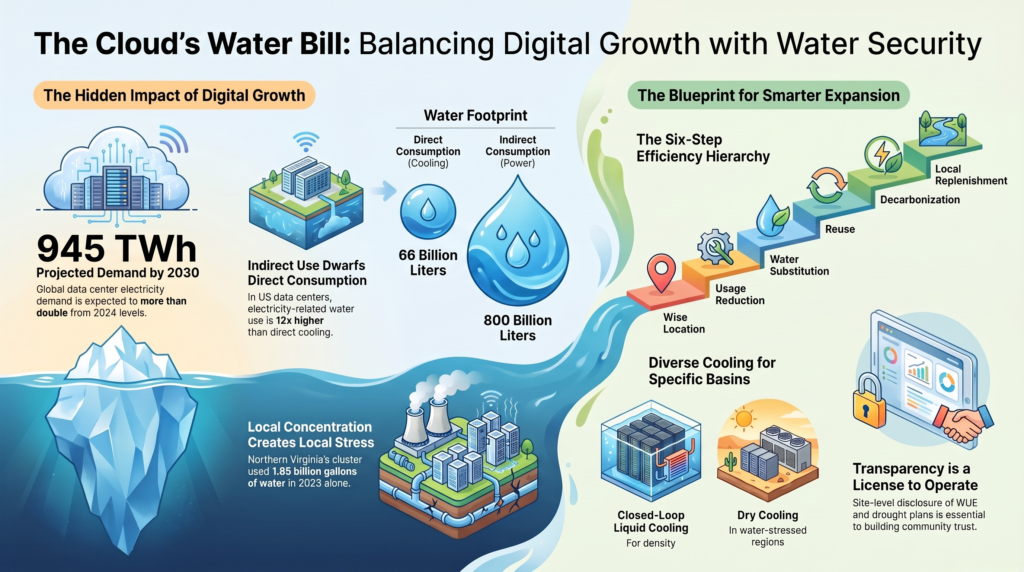
And AI will not wait. The International Energy Agency estimates that global data-center electricity demand could rise from about 415 terawatt-hours in 2024 to roughly 945 terawatt-hours by 2030.
We can debate that growth. Or we can design for it.
Serious countries and serious companies must do the second.
The liter most people never see
Every watt entering a server eventually becomes heat. That heat has to be removed continuously and without failure.
In an evaporatively cooled facility, water helps reject heat and part of it is consumed through evaporation. In a dry-cooled facility, direct water demand can fall dramatically, although power use may rise during hot weather. Direct-to-chip and immersion systems move heat efficiently away from high-density processors, but the final footprint still depends on how the heat is rejected and how the electricity is generated.
This is where simplistic claims fail.
Water withdrawn is not the same as water consumed. A closed internal loop is not automatically a waterless facility. And a campus reporting zero water for routine cooling can still have an upstream water footprint if its electricity comes from water-intensive generation.
Lawrence Berkeley National Laboratory estimated that US data centers directly consumed about 66 billion litrers of water in 2023. The water consumed indirectly through electricity generation was nearly 800 billion liters
That does not mean data centers are uniquely wasteful. It means the industry’s biggest opportunity may sit beyond the cooling tower.
Cleaner grids, more efficient computing and better workload placement can reduce both energy demand and water exposure at the same time.
This is exactly why the debate should move from protest slogans to system design.
Water impact is real, but context changes everything
Data centers do not use more water globally than agriculture, and they are not about to create worldwide scarcity on their own. Their global direct consumption remains small compared with farming, power generation and municipal supply.
The concern is local concentration.
A billion liters consumed in a water-rich basin is not equivalent to a billion litres taken from a depleted aquifer. Annual averages also hide the hardest moment: the hottest day of the year, when residents, farms, power stations and cooling systems may all need maximum supply.
That is why universal claims such as “one AI prompt consumes one bottle of water” are misleading. Berkeley Lab found that workload-level water use can vary by more than 10,000 times, depending on the server, utilisation, cooling technology, weather, location and electricity mix.
There is no honest universal water number for an AI prompt.
There is something more useful: a site-level engineering calculation.
Scarcity is a design constraint, not a verdict against growth
Half the world already experiences severe water scarcity for at least part of the year. Data-center developers cannot ignore that reality.
But water stress should guide where and how new capacity is built. It should not become a blanket argument for freezing digital infrastructure.
Consider the practical alternatives.
A facility in a water-rich, cool region may responsibly use limited evaporative cooling to reduce power demand. A campus in a hot, stressed basin may need dry cooling, reclaimed water or a hybrid system. High-density AI infrastructure may benefit from closed-loop direct-to-chip cooling. Flexible workloads may be scheduled for hours or regions where electricity and water impacts are lower.
The objective is not zero infrastructure impact. No hospital, airport, semiconductor plant or city has zero impact.
The objective is maximum social and economic value for the lowest responsible local footprint.
Four controversies that should improve the next generation
The Dalles, Oregon: Google’s local operations reportedly accounted for about 29% of city water use in 2021. The controversy intensified over access to water-use records. The lesson is not “do not build.” It is that secrecy destroys trust. Site-level disclosure should be part of the licence to operate.
Santiago, Chile: Concerns about climate pressure and groundwater contributed to reconsideration of a planned Google facility. Google later proposed an air-cooled redesign. This shows that engineering can adapt when local conditions demand it.
Northern Virginia: The world’s largest data-center cluster used at least 1.85 billion gallons of water in 2023, up from 1.13 billion gallons in 2019. State reviewers found overall use manageable while identifying local constraints and the need for forward planning. Growth and water security are compatible when utilities plan ahead of demand.
India: The market had around 271 data centers by January 2026 and is expanding quickly around Mumbai, Chennai, Hyderabad and Bengaluru. Yet only five of 15 state policies reviewed by CEEW contained explicit sustainability provisions. India should not slow this growth. It should use the investment cycle to establish world-class water, energy and disclosure standards from the beginning.
These cases are not warnings to retreat.
They are design briefs for the next generation.
The cooling choice is not ideological
Evaporative cooling is not automatically irresponsible. In the right watershed, it can reduce electricity demand and grid strain.
Dry cooling is not automatically sustainable. It may protect local water while increasing electricity use during the hottest hours.
Liquid cooling is not a synonym for water consumption. Direct-to-chip systems can circulate the same coolant repeatedly and support much higher computing density. The remaining question is how the captured heat is finally rejected.
Reclaimed wastewater can protect drinking-water supplies and sometimes finance better municipal infrastructure. Seawater and lake-water systems can conserve freshwater, although thermal discharge, ecology, corrosion and pumping energy must be assessed.
There is no universal winner.
There should be a universal decision principle: select the lowest combined water, energy and basin-stress impact for the specific site.
The industry is already proving that expansion can improve
The direction of travel is encouraging.
Microsoft is developing closed-loop direct-to-chip systems designed to eliminate routine evaporative water loss. AWS says it uses free-air cooling for most operating hours and reported a global WUE of 0.12 liters per kWh in 2025. Meta is moving some new designs toward closed-loop liquid cooling with dry coolers. Google evaluates recycled water and air cooling in higher-risk locations. Apple has pursued Alliance for Water Stewardship certification for several owned facilities.
Colocation providers are advancing too. Digital Realty is expanding non-potable water and water-free cooling. Equinix has introduced customer-level water reporting. NTT, STT GDC, CyrusOne and QTS are deploying combinations of closed-loop, dry, reclaimed-water and waterless designs.
These are not reasons to declare the problem solved. They are evidence that the industry can scale while changing its resource model.
One caution remains. “Water positive” normally refers to a calculated portfolio-level volume. It does not automatically mean that the same water was restored to the same community, in the same season and at the same quality.
Replenishment matters. Local relevance matters more.
A blueprint for building more, faster and better

First, locate wisely. Use forward-looking basin data, not only historical averages. Put the most water-intensive designs where water is abundant and drought risk is low.
Second, reduce. Improve server utilisation, model efficiency, temperature tolerances, airflow and cooling controls. More useful computing per litre is the goal.
Third, substitute. Replace potable water with reclaimed wastewater, captured rainwater or appropriately managed non-freshwater sources.
Fourth, reuse. Run closed loops, recover condensate, optimise cooling-tower cycles, treat blowdown and reuse captured heat where practical.
Fifth, decarbonise electricity. Wind and solar photovoltaic generation generally have much lower operational water consumption than conventional thermoelectric generation.
Sixth, replenish locally. Restore the same watershed with independently verified, additional and seasonally relevant benefits.
This hierarchy does not obstruct growth. It makes growth durable.
Regulation should reward good projects and accelerate them
Good environmental policy should not create years of uncertainty for every data-center proposal.
Governments can define clear performance thresholds and then fast-track projects that meet them. A predictable approval pathway could require basin-risk assessment, peak-day demand, potable-water limits, drought operating plans, WUE disclosure and grid-water analysis.
Projects using reclaimed water, closed-loop cooling, low-water electricity and independently verified local replenishment should receive faster permits, infrastructure coordination and appropriate incentives.
Projects that conceal demand or depend heavily on drinking water in critically stressed basins should face redesign.
That approach is pro-growth because it replaces ambiguity with rules.
The European Union has already begun requiring large data centers to report water, energy, renewable-energy and heat-reuse indicators. ISO/IEC 30134-9 provides a WUE framework. The Climate Neutral Data Center Pact offers a useful reference target of 0.4 L/kWh for certain new potable-water-cooled facilities in cool, water-stressed locations.
The next step is outcome-based regulation that distinguishes responsible projects from poorly designed ones.
Seven questions every board should ask before approving expansion
- Does the project increase national, regional or organisational digital resilience?
- Is the site suitable under current and projected basin-stress conditions?
- What will the facility withdraw and consume annually, seasonally and on its peak day?
- How much potable water is required during routine operation and drought conditions?
- What are the site WUE and electricity-related water footprint?
- Can reclaimed water, closed-loop systems, cleaner energy or workload flexibility reduce the impact?
- Are community benefits, infrastructure costs and local replenishment independently verified?
If management can answer those questions convincingly, approve the project and build it.
If it cannot, improve the design rather than abandoning the ambition.
The choice is not cloud or community
AI can help forecast floods, detect leaking pipes, optimise irrigation, discover new materials and improve power systems. Digital infrastructure can make the world more water-efficient, not less.
But those benefits require computing capacity.
We therefore need a more confident position: build more data centers. Build them closer to demand. Build them for resilience. Build them with transparent water accounting and engineering suited to the local watershed.
The future will not be served by pretending that digital demand can be wished away. Nor will it be served by treating freshwater as an invisible subsidy.
The world needs more data centers. The leaders will be those who prove that digital growth and water security can advance together.
Key sources
- Lawrence Berkeley National Laboratory: 2024 United States Data Center Energy Usage Report
- International Energy Agency: Energy and AI
- UNESCO World Water Development Report
- Berkeley Lab: Water use of data-center workloads
- ICEF Sustainable Data Centers Roadmap
- CEEW: India’s data-center power and water challenge
- ISO/IEC 30134-9:2022 Water Usage Effectiveness
- EU Regulation 2024/1364 on data-center sustainability reporting
- Virginia JLARC: Data Centers in Virginia
- Reporters Committee for Freedom of the Press: The Dalles water-records dispute
- Reuters: Google revises Chile data-center plan after environmental concerns
- Google 2026 Environmental Report
- Microsoft 2026 Environmental Sustainability Report
- AWS: Water stewardship and 2025 WUE
- Meta Engineering: cooling optimisation
