The Cloud Is Thirsty. And We Know How to Quench It Responsibly.
Why the answer to water pressure is smarter expansion, not slower digital growth ?
At 2:17 in the morning, a data center looks almost peaceful.
Rows of servers blink in perfect rhythm. Nothing appears to move. Yet inside those machines, a bank is detecting fraud, a hospital is retrieving a critical scan, an airline is recalculating routes, a government platform is authenticating a citizen and an AI system is helping an engineer solve a problem that once took days.
This is no longer optional infrastructure.
Data centers have become the factories, libraries, command posts and public squares of the digital economy. Every serious ambition in artificial intelligence, financial inclusion, healthcare, cybersecurity, sovereign cloud and scientific research depends on them.
The world will need many more.
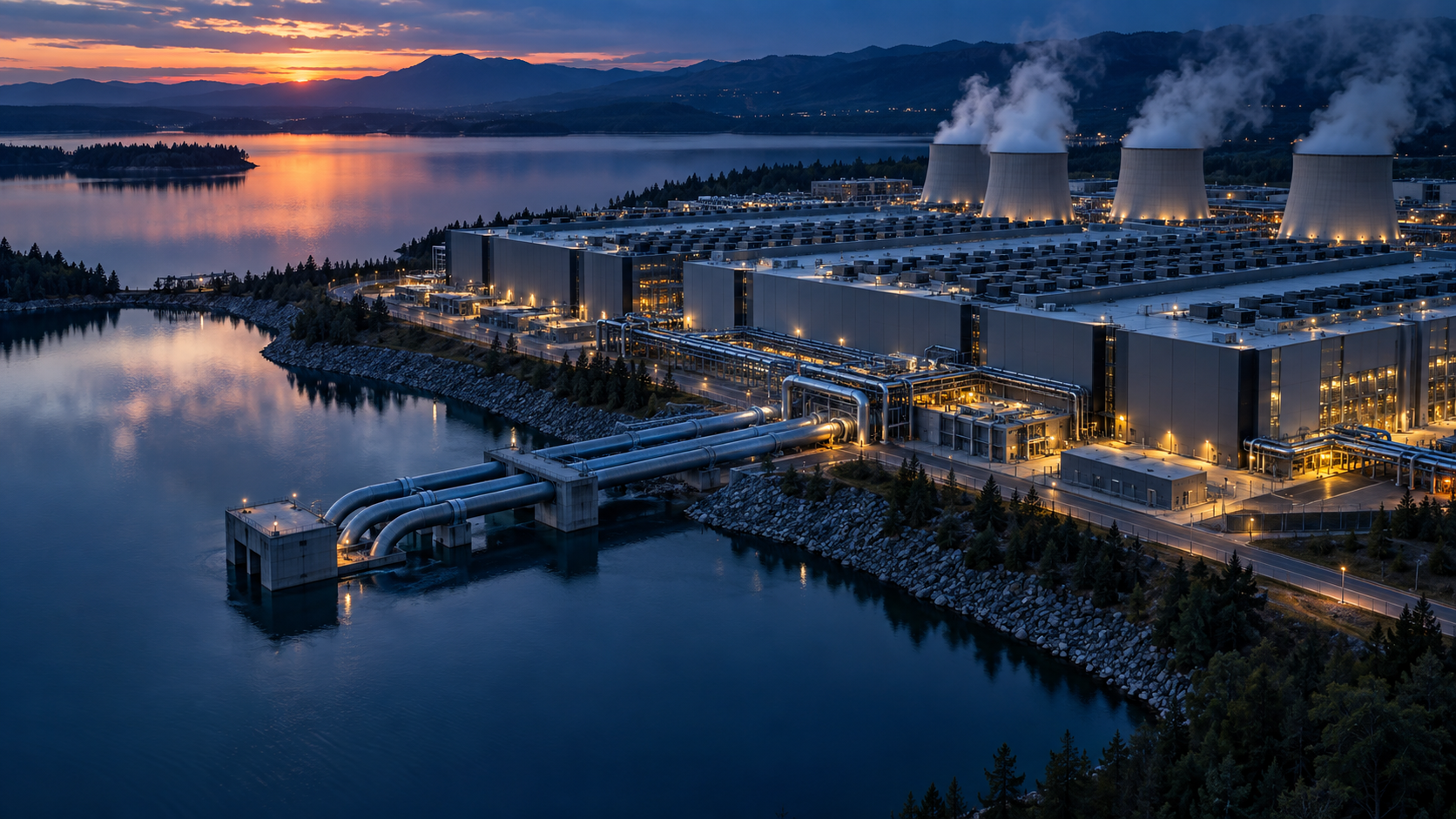
But behind the server hall, pumps are running. Heat is moving into pipes. Water may be passing through cooling equipment. Somewhere beyond the perimeter fence, a power station may be consuming even more water to generate the electricity keeping those servers alive.
The cloud has a physical address. And that address has a water bill.
Here is the important distinction: that bill is not an argument against building data centers. It is an argument for building them better.
The debate begins with the wrong question
The public discussion is often framed as a choice: data centers or water security. That is a false choice.
Stopping or slowing digital infrastructure would not make society more resilient. It would push computing capacity elsewhere, increase dependence on distant jurisdictions and weaken the local ecosystems needed for AI, cloud services and cybersecurity. It could also leave countries importing digital capability instead of creating it.
The right question is not, “Should we build more data centers?” We should.
The right question is, “How do we build far more capacity without exporting environmental cost to the communities hosting it?” That is an engineering, policy and leadership problem. And it is solvable.
The liter most people never see
Every watt entering a server eventually becomes heat. That heat has to be removed continuously and without failure.
In an evaporatively cooled facility, water helps reject heat and part of it is consumed through evaporation. In a dry-cooled facility, direct water demand can fall dramatically, although power use may rise during hot weather. Direct-to-chip and immersion systems move heat efficiently away from high-density processors, but the final footprint still depends on how the heat is rejected and how the electricity is generated.
Water withdrawn is not the same as water consumed. A closed internal loop is not automatically a waterless facility. And a campus reporting zero water for routine cooling can still have an upstream water footprint if its electricity comes from water-intensive generation.
Lawrence Berkeley National Laboratory estimated that US data centers directly consumed about 66 billion litrers of water in 2023. The water consumed indirectly through electricity generation was nearly 800 billion liters.
That does not mean data centers are uniquely wasteful. It means the industry’s biggest opportunity may sit beyond the cooling tower.
Scarcity is a design constraint, not a verdict against growth
Half the world already experiences severe water scarcity for at least part of the year. Data-center developers cannot ignore that reality.
But water stress should guide where and how new capacity is built. It should not become a blanket argument for freezing digital infrastructure.
A facility in a water-rich, cool region may responsibly use limited evaporative cooling to reduce power demand. A campus in a hot, stressed basin may need dry cooling, reclaimed water or a hybrid system. High-density AI infrastructure may benefit from closed-loop direct-to-chip cooling. Flexible workloads may be scheduled for hours or regions where electricity and water impacts are lower.
The objective is not zero infrastructure impact. No hospital, airport, semiconductor plant or city has zero impact. The objective is maximum social and economic value for the lowest responsible local footprint.
A blueprint for building more, faster and better
First, locate wisely. Use forward-looking basin data, not only historical averages. Put the most water-intensive designs where water is abundant and drought risk is low.
Second, reduce. Improve server utilisation, model efficiency, temperature tolerances, airflow and cooling controls. More useful computing per litre is the goal.
Third, substitute. Replace potable water with reclaimed wastewater, captured rainwater or appropriately managed non-freshwater sources.
Fourth, reuse. Run closed loops, recover condensate, optimise cooling-tower cycles, treat blowdown and reuse captured heat where practical.
Fifth, decarbonise electricity. Wind and solar photovoltaic generation generally have much lower operational water consumption than conventional thermoelectric generation.
Sixth, replenish locally. Restore the same watershed with independently verified, additional and seasonally relevant benefits.
This hierarchy does not obstruct growth. It makes growth durable.
The choice is not cloud or community
AI can help forecast floods, detect leaking pipes, optimise irrigation, discover new materials and improve power systems. Digital infrastructure can make the world more water-efficient, not less.
But those benefits require computing capacity.
We therefore need a more confident position: build more data centers. Build them closer to demand. Build them for resilience. Build them with transparent water accounting and engineering suited to the local watershed.
The future will not be served by pretending that digital demand can be wished away. Nor will it be served by treating freshwater as an invisible subsidy.
The world needs more data centers. The leaders will be those who prove that digital growth and water security can advance together.

Instincts built hunting signals at sea, sharpened for two decades against digital adversaries. Not machine-written. Machine-proofread, comma by comma. Everything else, the noticing, the arguing, the getting it wrong sometimes, is mine. The bytes are for everyone; the opinions are only ever mine.
“Until the lion learns how to write, every story will glorify the hunter.” This is the lion's version.