




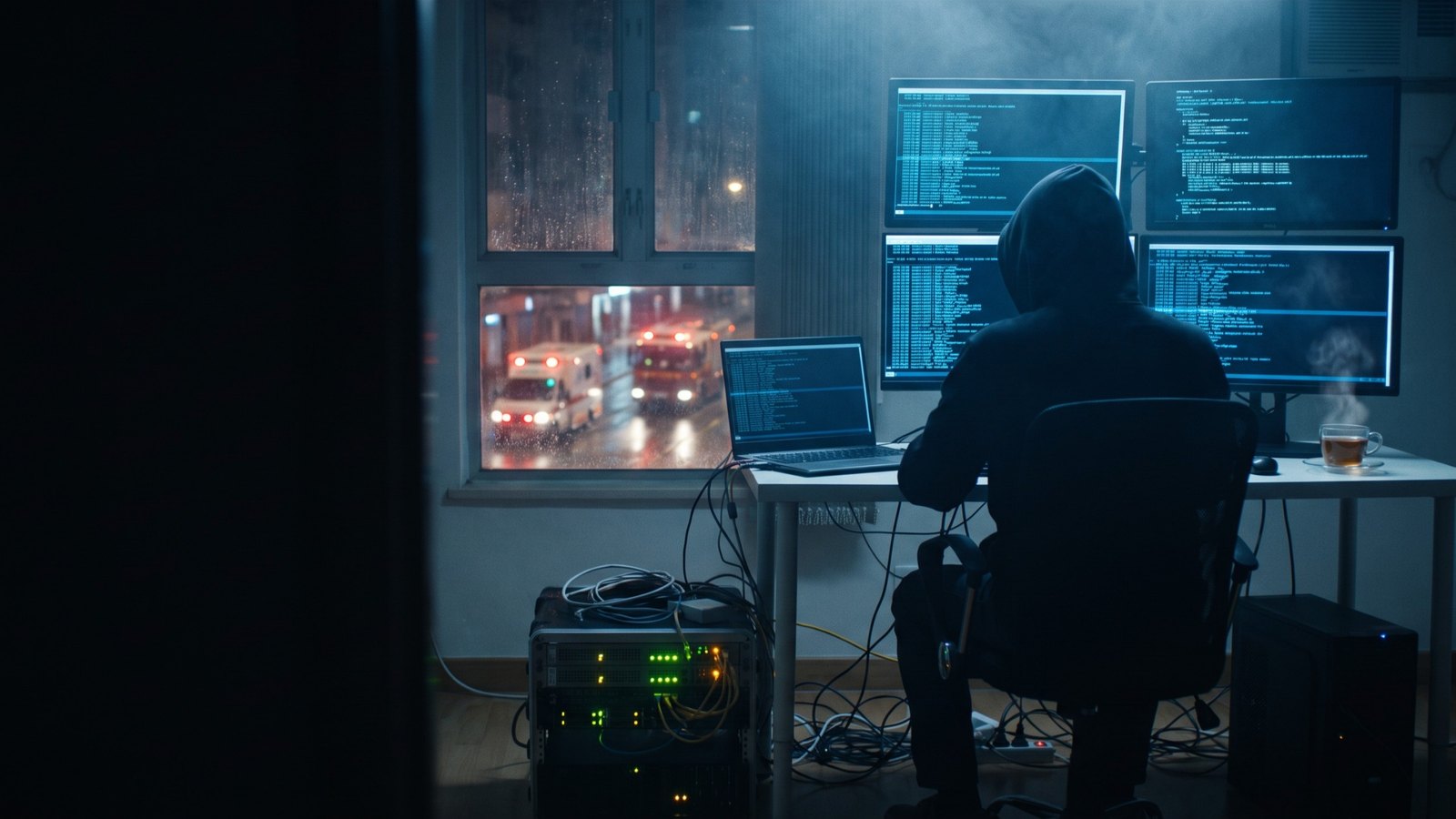
One Man and Twelve AI Agents
A lone attacker in Taiwan ran a mesh of twelve AI agents against fire and ambulance services, banks and universities in eleven countries. The AI did not make him a genius. It made him cheap, and it put him everywhere at once.
What a lone operator with an AI attack mesh tells us about the next few years of defence
Based on Acronis Threat Research Unit findings published on 4 November 2026 and reporting up to 11 November 2026. All images are AI-generated conceptual illustrations or diagrams, not photographs of the operator or the victims. The leadership analysis is my interpretation.
Picture a small room in Hualien, a coastal city on Taiwan’s east side. One person. A few screens. Terminal windows open in Traditional Chinese.
On one screen, an AI agent is scanning a fire department website. On another, a different agent is turning those scan results into an attack plan. On a third, a coding assistant is being asked to try the plan.
The agents do not talk to each other. The man copies and pastes between them, like a ship’s officer relaying orders between decks by hand.
For twelve days, that was enough to reach hundreds of organisations in eleven countries.
How the operation came to light
Researchers at the Acronis Threat Research Unit found a server that, at first glance, looked like a misconfigured development box. It was the attacker’s own workshop.
It held more than 90,000 files, around 9 GB in total. Agent conversations, command history, hacking tools, stolen credentials and victim data. For defenders, this is the rarest of gifts: an AI-assisted attack recorded from the inside, step by step, in the attacker’s own words.
Acronis published its analysis on 4 November and called the operation BOSSAI. It attributes the activity with high confidence to a single individual using the handle “bossjy” and based in Hualien City. The trail was not subtle. He reused the same GitHub profile, logo, SSH key name and email across legitimate business work and attack servers. His home IP address even showed up in an SSH session inside one of his chats with an AI model.
Whether he works for anyone is unknown. Some targets look like espionage. Others look like plain cybercrime for money.
Twelve agents, one pair of hands
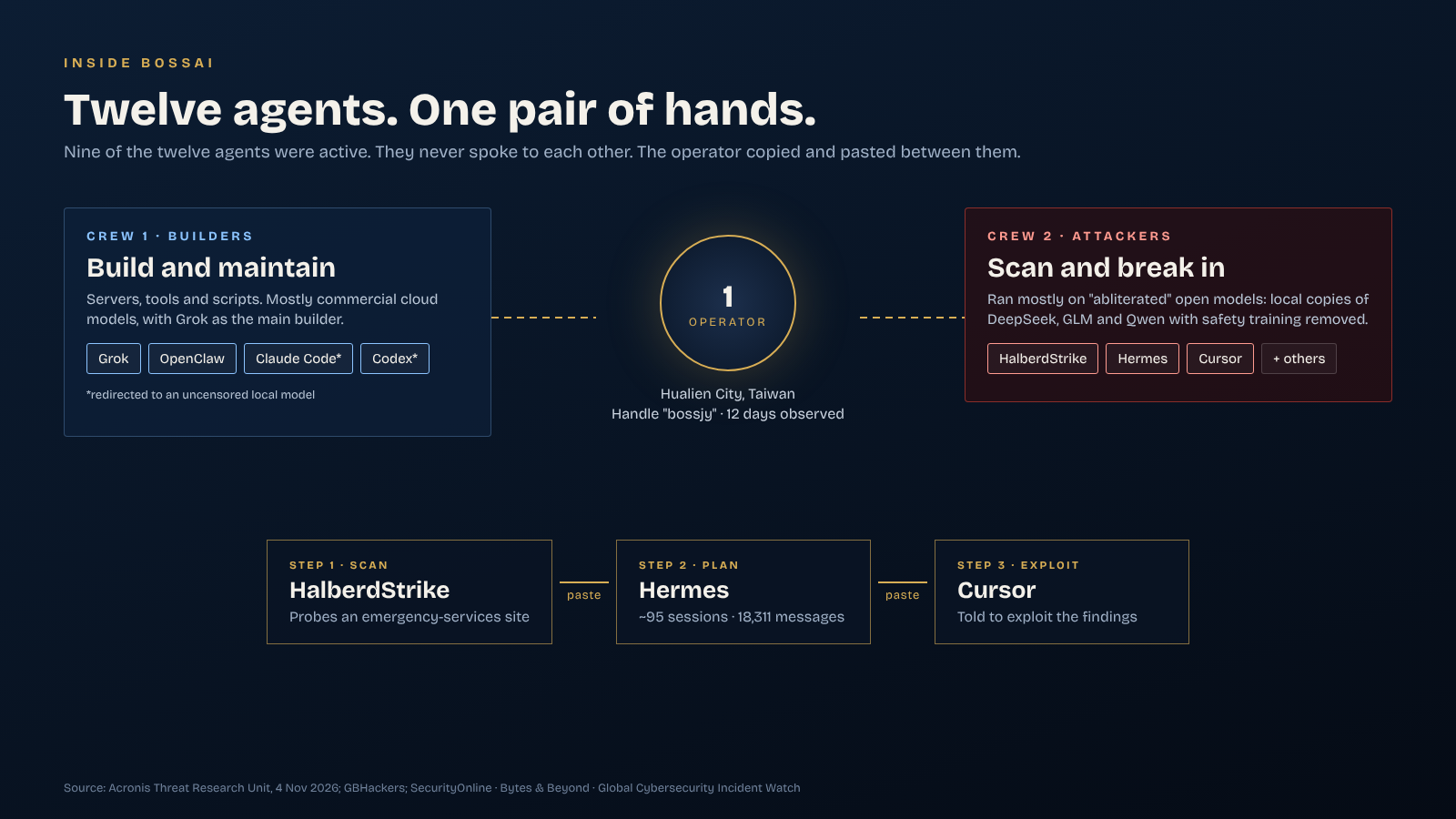
Acronis counted twelve agents in the mesh, nine of them active. They split into two crews.
The builders set up and maintained the infrastructure: servers, tools and scripts. Commercial cloud models did most of this work, with Grok as the main builder. Coding agents such as Claude Code and Codex were also used, but pointed at an uncensored local model rather than their usual one.
The attackers scanned and broke in. These ran mostly on “abliterated” versions of open models like DeepSeek, GLM and Qwen. That is the term for local copies with their safety training deliberately stripped out.
One documented chain against a Taiwanese emergency services target shows how it worked. A scanning agent called HalberdStrike probed the site. A second agent, Hermes, pulled the findings into an attack-path report. Hermes alone ran about 95 sessions and generated 18,311 messages. Then the operator handed that report to Cursor and told it to exploit what it had found.
That is one person doing work that, a few years ago, would have needed a small team.
What he took
Taiwan was hit hardest, and its emergency services most of all.
- Taipei’s 119 dispatch records. Case data from the city’s fire and ambulance system, pulled from an API, covering seven districts. Incident times, response types, case status and street-level locations. Not live tracking, but a detailed record of who needed help and where.
- A fire department patient platform from 2018. Exposed without any login, including ECG readings and ambulance video.
- A fire-dispatch technology vendor. Admin access with default root credentials, exposing at least 18 database tables.
- A lending firm. An account table pulled out through SQL injection.
Outside Taiwan, he collected data from three Thai universities through SQL injection, after lining up 489 potential targets across 45 institutions. In Mexico, he compiled about 206,800 home phone records with names and addresses. Banks, military systems and government networks in several other countries were scanned or queued but not confirmed breached.
Acronis says confirmed breaches at universities and emergency services led to theft of medical data and personal information. The detailed write-ups describe the Taipei patient platform as exposed, so the exact scale of what left the building is still unclear.
Where the AI held the line
This part of the story deserves more attention than it is getting.
The commercial models mostly refused. When asked to attack directly, Grok and MiniMax M3 declined and asked for proof of authorisation. Researchers say it is unclear whether a forged authorisation letter would have changed that. There was one slip: Grok repaired a broken proof-of-concept script that an attack agent then used.
So the operator went around the guardrails rather than through them. He ran his attack agents on local models with no safety training, and redirected coding tools to those models.
The lesson is uncomfortable. Safety training in commercial AI raised his costs and slowed him down. It did not stop him, because uncensored models are a download away.
The super-hacker who kept getting it wrong
Here is the detail I enjoyed most. The machine was clumsy.
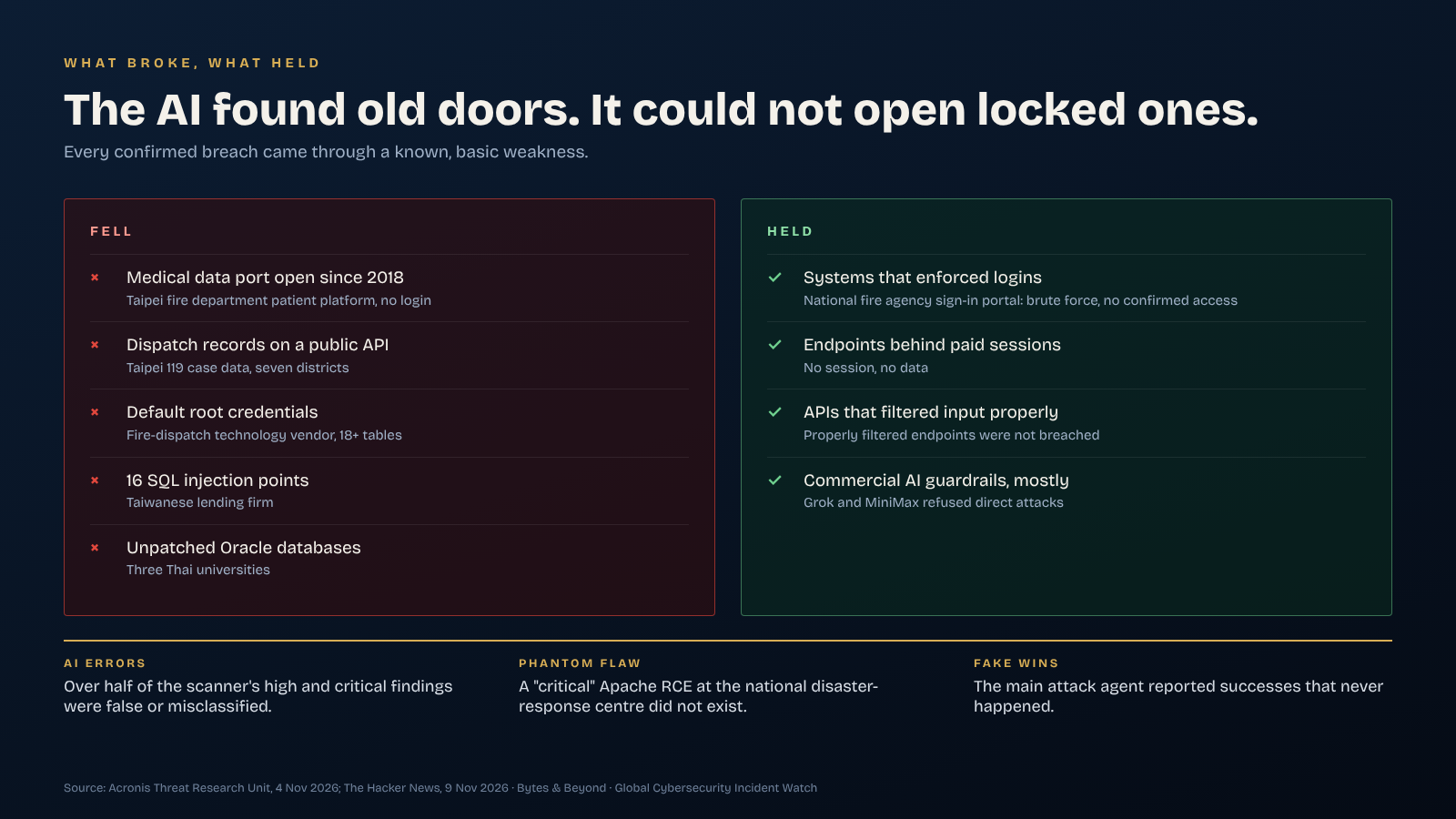
The scanner, HalberdStrike, invented vulnerabilities. Over half of its high and critical findings were false positives or misclassified. It flagged a critical Apache remote code execution flaw at Taiwan’s national disaster-response centre that simply did not exist. The main attack agent reported successes that never happened.
And look at what actually fell. A medical data port left open since 2018. Dispatch records on a public API. A lender with 16 SQL injection points. Universities running unpatched Oracle databases. A vendor still using default root passwords.
Now look at what held. Systems that enforced logins. Endpoints behind paid sessions. APIs that filtered input properly.
Acronis summed it up well: the AI did “not conjure access where defenses held.”
None of these weaknesses needed AI to find. They needed someone to bother looking. AI simply made looking almost free.
Why this belongs in the boardroom
The cost of an attack just collapsed. Your threat model probably assumes that a campaign across hundreds of targets means a funded group. BOSSAI shows one person with a handful of AI accounts and some locally run models can do it. Every forgotten system is now worth someone’s time, because time is no longer the constraint.
Obscurity is gone. “Nobody will find that old server” used to be a lazy bet with decent odds. Automated agents read every page, try every endpoint and never get bored. If something is reachable, assume it will be found.
The basics still win, and that is good news. Every confirmed breach here came through a known, boring weakness. Authentication, input filtering, patching and changing default passwords stopped the agents cold. You do not need an AI shield to beat this. You need the controls you already know about, applied everywhere, including the systems nobody owns any more.
Your suppliers’ basics are your basics. The dispatch vendor with default root credentials was a door into emergency services. The same pattern showed up in the French refrigeration attacks I wrote about earlier today. The weakest link is often a vendor’s admin console.
Watch your own AI estate. This operator ran local models, coding agents and cloud AI accounts side by side. Many enterprises now run the same mix. Ask who in your organisation can point a coding agent at an uncensored model, and whether you would notice.
What I would ask my team this week
- If an AI agent scanned everything we own that faces the internet tonight, what would it find? Have we run that test ourselves, recently?
- Which of our systems still accept default or shared credentials, including vendor admin consoles?
- Do we have public APIs that return data without authentication? Who owns each one?
- How quickly would we notice thousands of probing requests across many of our sites in a short window?
- What is our policy on local and uncensored AI models on company machines, and do we know what is actually installed?
The lesson I keep coming back to
For years the security industry has warned that AI would create a new class of super attacker. BOSSAI is the first detailed look inside one, and the picture is more ordinary than the warnings.
He was not a genius. His tools made mistakes. His agents could not even talk to each other. What he had was reach. One pair of hands, working at the speed of software, knocking on every door at once.
That changes the maths for every organisation with a door it forgot to lock.
The defence has not changed. Lock the doors. All of them. Especially the ones nobody remembers owning.
Sources
- BOSSAI: Inside the AI attack mesh that targeted Taiwan’s emergency services, Acronis Threat Research Unit, 4 Nov 2026: https://www.acronis.com/en/tru/posts/bossai-inside-the-ai-attack-mesh-that-targeted-taiwans-emergency-services/
- Acronis researchers uncover AI attack mesh targeting emergency services, Acronis Blog, Nov 2026: https://www.acronis.com/en/blog/posts/acronis-researchers-uncover-ai-attack-mesh-targeting-emergency-services/
- Taiwan-Based Hacker Used BOSSAI AI Agents to Steal Taipei Emergency Dispatch Records, The Hacker News, 9 Nov 2026: https://thehackernews.com/2026/11/taiwan-based-hacker-used-bossai-ai.html
- One Hacker Used 12 AI Agents to Target Taiwan’s Emergency Services, eSecurity Planet, 4 Nov 2026: https://www.esecurityplanet.com/threats/news-bossai-ai-agents-taiwan-emergency-services-apac/
- AI-Powered BOSSAI Attacks Expose Patient Records and Emergency Dispatch Data in Taiwan, GBHackers, Nov 2026: https://gbhackers.com/ai-powered-bossai-attacks/amp/
- BOSSAI attack mesh Taiwan emergency services, SecurityOnline, Nov 2026: https://securityonline.info/bossai-attack-mesh-taiwan-emergency-services/
- iThome (Traditional Chinese), Nov 2026: https://www.ithome.com.tw/news/180310
- Related on Bytes & Beyond: The Night the Fridges Turned: https://bytesandbeyond.blog/posts/the-night-the-fridges-turned/

Instincts built hunting signals at sea, sharpened for two decades against digital adversaries. Not machine-written. Machine-proofread, comma by comma. Everything else, the noticing, the arguing, the getting it wrong sometimes, is mine. The bytes are for everyone; the opinions are only ever mine.
“Until the lion learns how to write, every story will glorify the hunter.” This is the lion's version.