
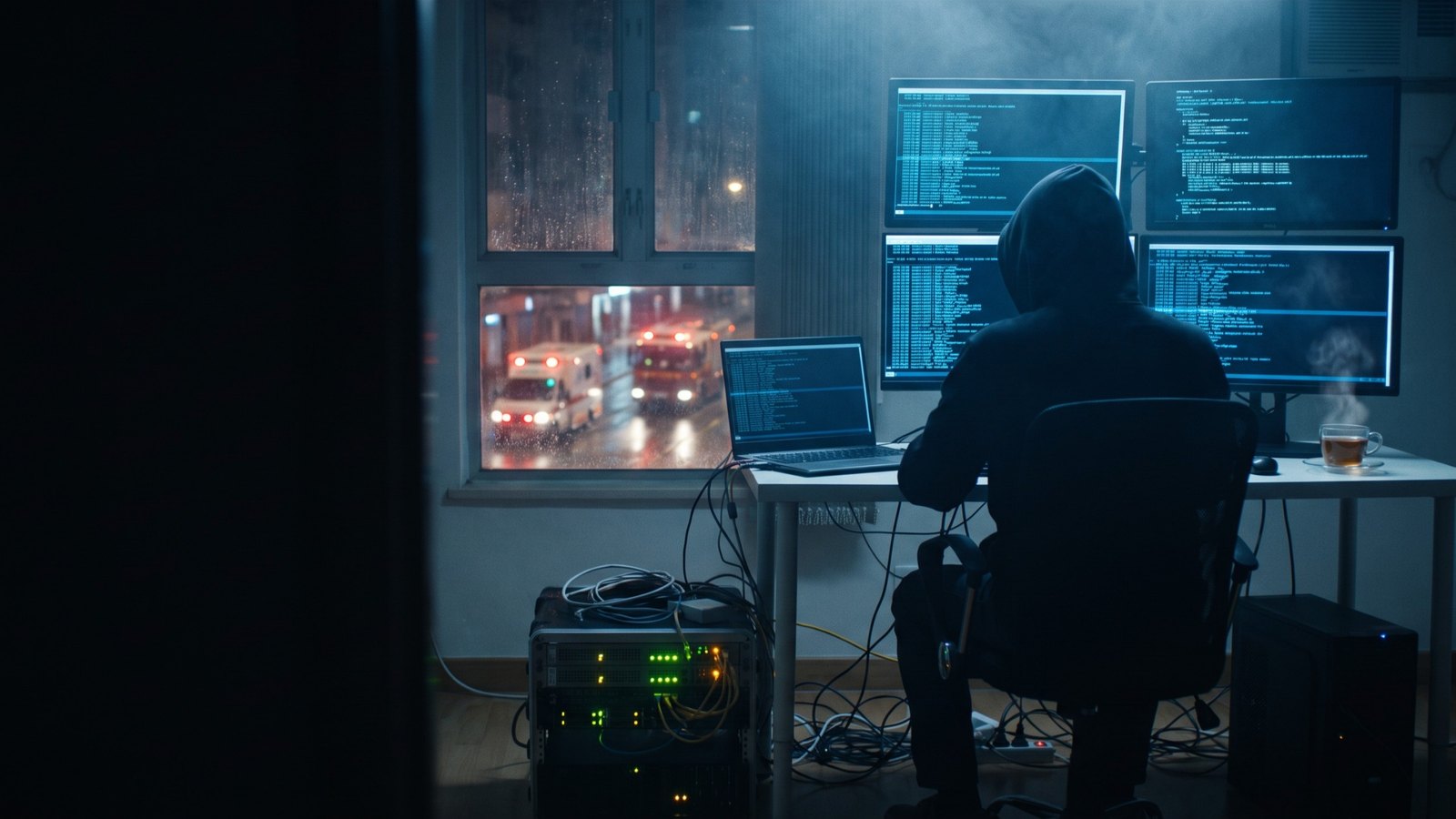




The Night the Fridges Turned
On 11 October, someone switched hundreds of French supermarket fridges into ovens. This week France blamed a unit of Iran's Revolutionary Guard. What happened, how it worked, and what every board should take from it.
How 700 French supermarkets became a state sabotage target, and the questions every board should ask
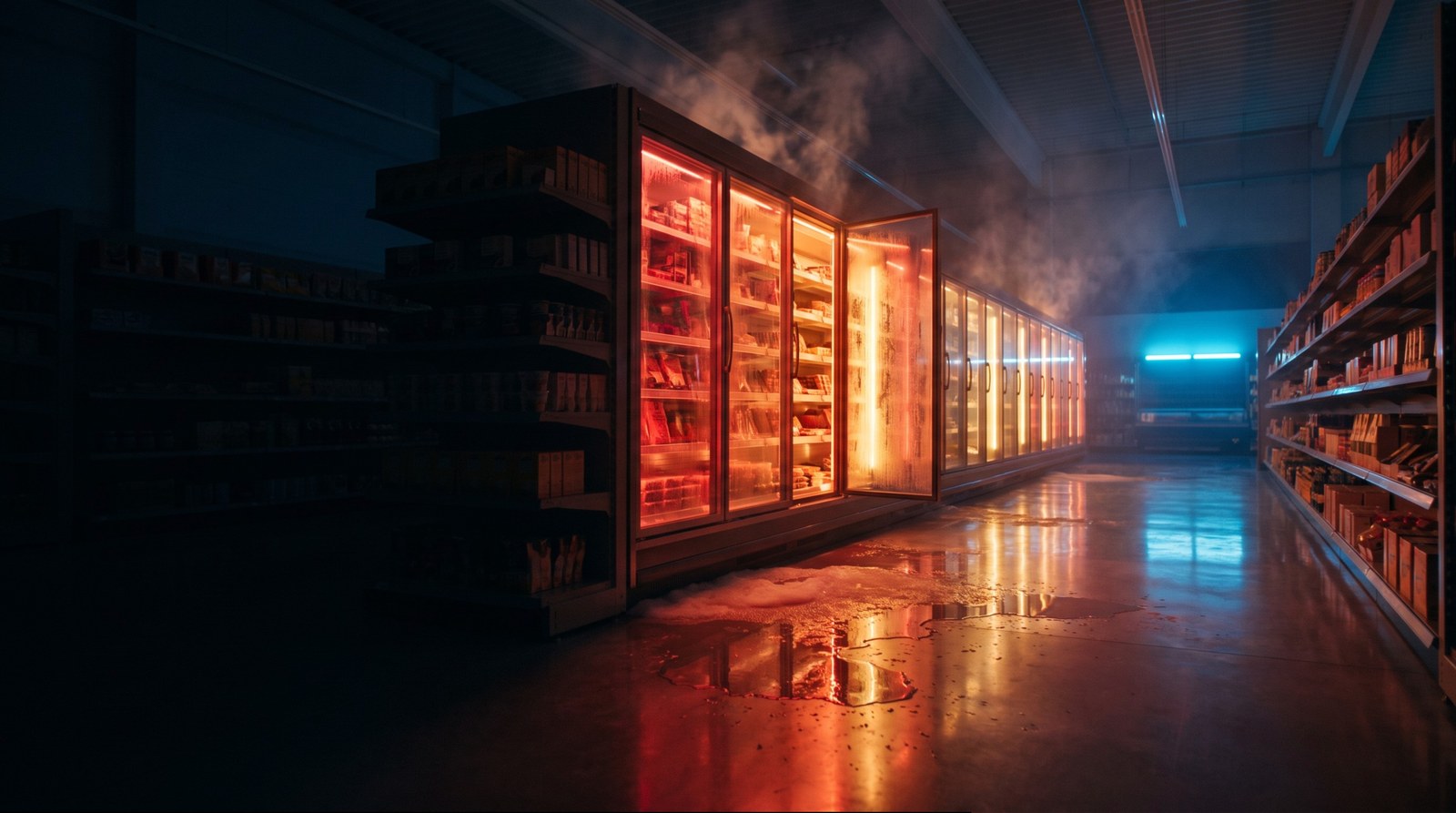
Based on reporting available on 11 November 2026. All images are AI-generated conceptual illustrations or diagrams, not photographs of the incident. The leadership analysis is my interpretation, not a finding about any retailer’s internal controls.
It is a Sunday night in October. The shutters are down at a few hundred supermarkets across France. The night crews have gone home. In the back rooms, small grey boxes keep doing the job they have done for years: telling the chillers when to cool and when to defrost.
Then, sometime after dark on 11 October, the boxes start taking orders from somebody else.
Defrost cycles switch on and never switch off. The upper temperature limits get pushed far past anything a freezer should ever see. The alarms that would normally wake a duty manager are quietly turned off. By the time staff open up on Monday morning, cabinets that should sit near minus 20 are warm. In some stores the readings climbed as high as 50°C. In more than a dozen, there was fire.
On Monday 9 November, the French government said who it believes did it. And that is why this story is back on my desk.
What France is saying
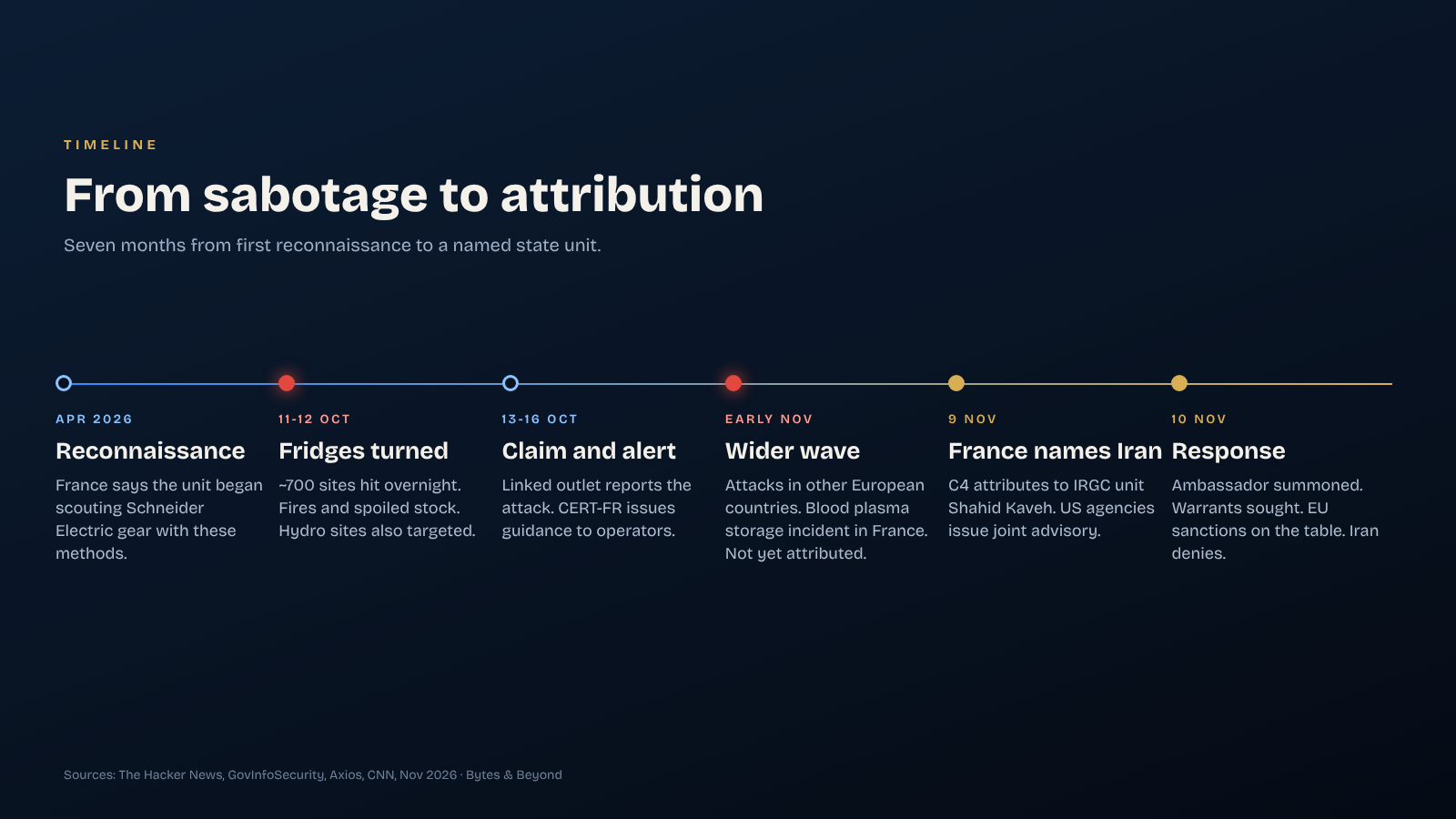
France’s Ministry for Europe and Foreign Affairs has attributed the campaign to Iran. Its cyber crisis coordination centre, known as C4, names a specific unit: Shahid Kaveh, part of the Islamic Revolutionary Guard Corps’ electronic and cyber centre. This is the same outfit that has long hidden behind hacktivist names such as CyberAveng3rs.
The numbers France has put on the record:
- About 700 retail sites had refrigeration controllers tampered with. Finance Minister Roland Lescure put it at roughly 700 of the country’s 10,000 supermarkets.
- At least 15 fires, according to C4. Some reports say closer to 20. That figure is still not settled.
- Food losses the Foreign Ministry estimates at several tens of millions of euros.
- The same operation went after Schneider Electric equipment at several small hydroelectric sites. France describes the effect there as “moderate”.
Foreign Minister Jean-Noël Barrot called it the first large-scale sabotage cyberattack on French soil. That phrasing matters. This was not theft. Nobody was holding data for ransom. The aim, as France sees it, was simply to break things in the physical world.
Paris has moved fast on the response. Prosecutors have requested international arrest warrants for the unit’s leadership. Iran’s ambassador was summoned on Tuesday. France wants new EU sanctions, and EU foreign ministers are due to discuss it next week. Tehran has rejected the accusation as baseless and hostile.
How a fridge becomes a furnace
The technical story is almost embarrassingly simple, and that is the uncomfortable part.
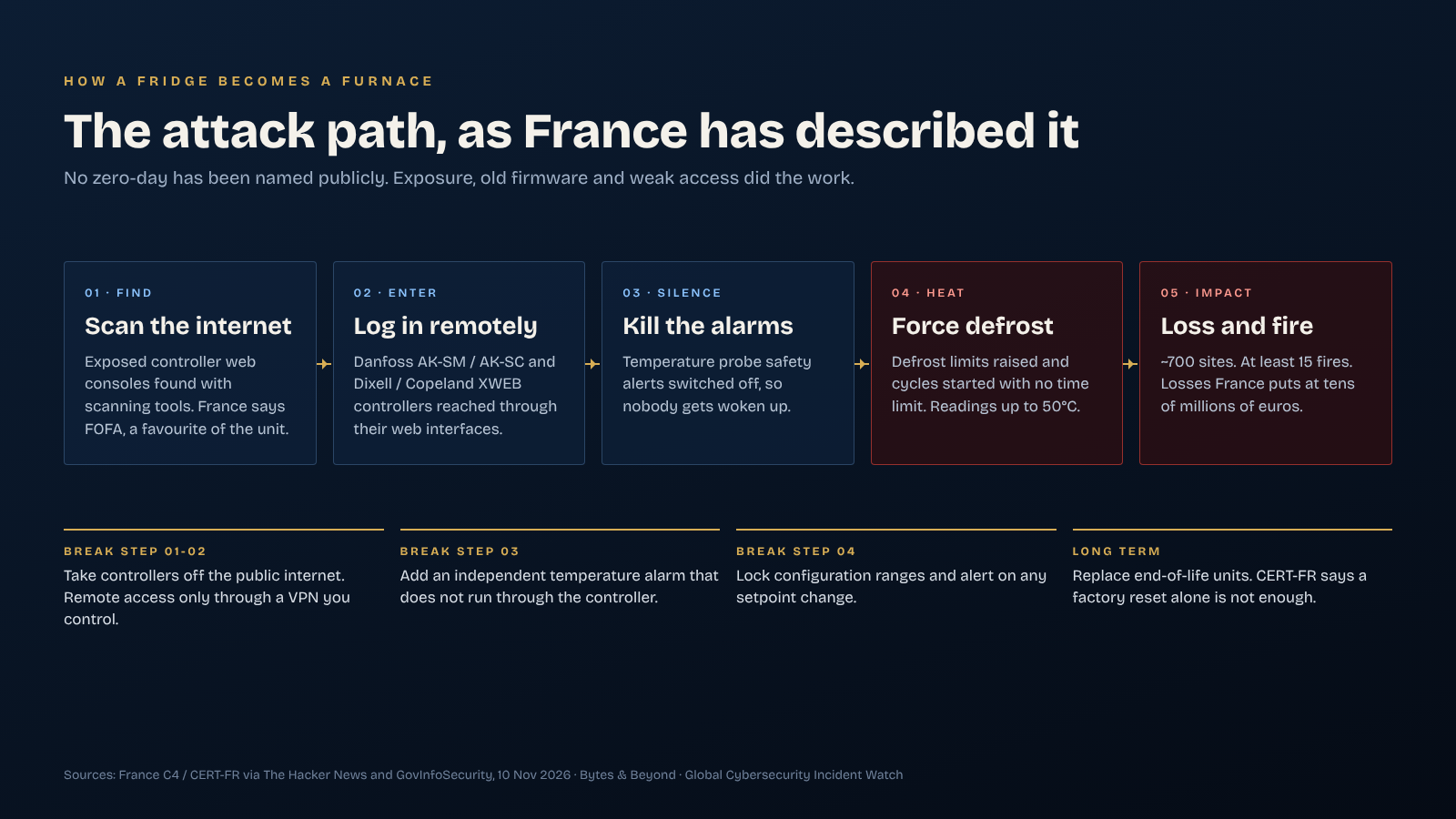
Large stores run their refrigeration through central management controllers. In France the units involved were Danfoss AK-SM and AK-SC series devices, plus Dixell and Copeland XWEB controllers. Reporting has singled out the AK-SM800 and AK-SC355 as legacy products. Danfoss said the affected units were running outdated firmware.
These controllers come with web interfaces so technicians can tune settings without driving to every store. Many of those web interfaces were sitting on the open internet.
According to the French reporting, the attackers reached them through those interfaces and changed three things. They raised the allowed defrost temperatures. They started defrost cycles with no time limit. And they disabled the safety alerts from the temperature probes. The kit did exactly what it was told. Heat built up, food spoiled, and in some cases things caught fire.
There is no sign of a clever zero-day in what has been published so far. The specific vulnerability, if there was one, has not been named. What has been described is exposure, old firmware and weak access control. That should worry you more than an exotic exploit would, because it is the most common condition in operational technology everywhere.
How France pinned it on Iran
Attribution is hard, and a government announcing it is not the same as independent proof. So it is worth looking at what France actually cited.
C4 and the prosecutors pointed to:
- the same attack infrastructure being reused to scout Schneider Electric gear at energy and water sites, using methods Shahid Kaveh has used since at least April
- use of FOFA, an internet scanning tool the unit is known to favour
- traces of Persian in the infrastructure, and IP addresses leading to devices in Iran
- a propaganda outlet linked to the unit, CyberbanNews, reporting the attack on 13 October
None of this has been independently verified in public yet. The full technical report sits with CERT-FR. But the pattern fits a long record. CISA warned in 2023 about CyberAveng3rs breaking into Unitronics PLCs at US water utilities. It warned again in April this year that Iran was going after internet-connected PLCs in American critical infrastructure. The playbook has been public for years.
The part that isn’t finished
Two things keep this story open.
First, it did not stop in France. In early November, refrigeration attacks hit stores in other European countries. On 9 November, CISA, the FBI and three other US agencies issued a joint advisory warning that attackers worldwide are going after refrigeration and cold-chain controllers, naming Danfoss StoreView and Copeland/Dixell XWEB. Their reporting covers targets in roughly 12 countries.
Second, the French Blood Establishment said an incident at one of its equipment providers pushed settings to “extremely high levels” at three plasma storage sites. Nobody has attributed that one. It may be the same actor, a copycat, or something else. France’s attribution does not cover the wider European wave, and I would not assume it does.
There is one small piece of good news. Censys data cited in coverage of the US advisory shows internet-exposed Danfoss StoreView systems fell from 3,004 to 708 between 9 October and 5 November. People pulled the plug once they knew. Most of what is left is still in France. And Copeland/Dixell XWEB exposure only dropped from 3,708 to 2,420. That is a lot of fridges still answering strangers.
Why this belongs in the boardroom
It is easy to read this as a retail story. I think that misses it.
Your physical risk now has an IP address. Most boards have a decent picture of their laptops, servers and cloud accounts. Very few could tell you how many chillers, HVAC units, building management systems or pumps in their estate can be reached from the internet, or who holds the logins. This attack went through exactly that blind spot.
The vendor’s remote access is your attack surface. E.Leclerc said publicly that the attack hit one of its refrigeration equipment suppliers. The EFS incident also came through an equipment provider. Remote access gets added for the convenience of whoever maintains the kit. When that access is weak, the loss still lands on the retailer’s balance sheet.
Geopolitics now reaches the grocery aisle. France is not fighting in the war between Iran and the US and Israel, though it did let US aircraft use a French air base for support. It still took the hit. If your business has any connection to a contested region, even a loose one, a state actor may treat you as fair game. Food, water and energy are the obvious targets because the disruption is visible to the public.
Safety alarms are a target, not a backstop. The attackers turned off the probe alerts before the heat built up. If your safety monitoring runs through the same controller that can be tampered with, it is not independent. That is a design problem, and patching alone will not solve it.
What I would ask my team this week
These are the questions I would put on the table, in plain words:
- Can we produce a list of every OT and building device we own that can be reached from the internet? If the answer takes more than a few days, that is the finding.
- Which third parties have remote access to those devices, and how? Shared passwords, open web consoles and old VPN accounts should come off first.
- Are any of our controllers end-of-life? CERT-FR’s guidance is blunt: an exposed end-of-life device carries very high compromise risk, and a factory reset alone does not fix it. Budget for replacement.
- Do we have an alarm path that does not depend on the device being attacked? A cheap independent temperature sensor sending its own alerts would have bought hours in this case.
- When did we last rehearse a physical-impact cyber scenario with operations, legal and communications in the room? Spoiled stock and a store fire are a very different crisis from a data breach.
The lesson I keep coming back to
For years we have talked about cyber-physical attacks as a future problem, something for power grids and pipelines. This one used supermarket fridges. The devices were cheap, ordinary and forgotten. The damage was tens of millions of euros, fires, and empty shelves in hundreds of towns.
The attackers did not need to be brilliant. They needed us to be careless with things we stopped thinking of as computers.
Go and find the boxes in your back rooms. Somebody else may already have.
Sources
- France Blames Iran for Sabotage Attack on Refrigeration Controllers at About 700 Retail Sites, The Hacker News, 10 Nov 2026: https://thehackernews.com/2026/11/france-blames-iran-for-sabotage-attack.html
- France Blames Iran for Cyberattacks on Supermarkets, GovInfoSecurity (ISMG), 10 Nov 2026: https://www.govinfosecurity.com/france-blames-iran-for-cyberattacks-on-supermarkets-a-33345
- France blames Iran for supermarket fridge hacks, Axios, 10 Nov 2026: https://www.axios.com/2026/11/10/france-iran-supermarket-refridgerator-hacks
- France blames Iran for “unprecedented” supermarket fridge cyberattack, CNN via KESQ, 10 Nov 2026: https://kesq.com/news/national-world/cnn-world/2026/11/10/france-blames-iran-for-unprecedented-supermarket-fridge-cyberattack/
- U.S. Agencies Warn Refrigeration Controller Attacks Could Cause Fires and Inventory Losses, The Hacker News, 9 Nov 2026: https://thehackernews.com/2026/11/us-agencies-warn-refrigeration.html
- C4 joint report CERTFR-2026-CTI-009, CERT-FR: https://cert.cyber.gouv.fr/cti/CERTFR-2026-CTI-009/
- CERT-FR alert CERTFR-2026-ALE-012: https://cert.cyber.gouv.fr/alerte/CERTFR-2026-ALE-012
- French Foreign Ministry attribution statement: https://www.diplomatie.gouv.fr/fr/presse-et-ressources/decouvrir-et-informer/actualites/declaration-d-attribution-a-l-iran-de-cyberattaques-visant-la-france
- Why supermarkets have become a target for hackers, Al Jazeera, 13 Oct 2026: https://www.aljazeera.com/economy/2026/10/13/french-fridge-fright-why-supermarkets-have-become-target-for-hackers
- French cybersecurity authority warns attack may be ongoing, AP via Manufacturing.net, Oct 2026: https://www.manufacturing.net/supply-chain/news/22976494/french-cybersecurity-authority-warns-attack-may-be-ongoing-as-stores-scramble-to-restock
- CISA advisory AA23-335A (CyberAv3ngers and Unitronics PLCs): https://www.cisa.gov/news-events/cybersecurity-advisories/aa23-335a

Instincts built hunting signals at sea, sharpened for two decades against digital adversaries. Not machine-written. Machine-proofread, comma by comma. Everything else, the noticing, the arguing, the getting it wrong sometimes, is mine. The bytes are for everyone; the opinions are only ever mine.
“Until the lion learns how to write, every story will glorify the hunter.” This is the lion's version.